
Onchain Domain Custody, Wallets, and Recovery
How custody really works for onchain domains: wallets, multisig, seed-phrase risk, and recovering a tokenized domain after wallet loss.
- domains
- domain-flipping
- web3
- explainer

When you flip a traditional domain, custody is somebody else's problem. The name lives in a registrar account, and if you forget the password there's a reset link and a support queue waiting for you. Move a domain on-chain and that safety net disappears. The token is the deed, and the keys to your wallet are the only thing standing between you and the asset. That shift is the single biggest mental adjustment for anyone coming to onchain flipping from the traditional aftermarket.
This piece is the custody chapter of the domain flipping series. It covers what custody actually means for a tokenized name, the real ways people lose access, the wallet setups that prevent it, and — honestly — what recovery looks like when prevention fails. If you trade onchain names, treat this as operational hygiene, not background reading.
What "custody" means once a domain is a token
A tokenized domain is a real, ICANN-recognized name with its ownership also represented as a token on a blockchain, usually an NFT following the ERC-721 standard — which the spec itself describes as a standard interface for non-fungible tokens, also known as deeds. The wallet holding that token normally controls token-authorized actions, but the token is not a deed in the legal-property sense and does not displace the registrar, registry, ICANN-policy, contract, or court-order layers that govern the underlying domain registration.
This is worth being precise about, because three things that all get called "Web3 domains" have very different custody and resolvability profiles, and conflating them leads to bad decisions:
- Tokenized ICANN domains (the Namefi model) — a real
.com,.xyz, or.iothat resolves in any browser, with an onchain token representing ownership actions within the platform's domain-management system. Wallet control matters, but it remains subject to the platform's contracts and the underlying registrar, registry, ICANN-policy, and legal layers. Resolvability uses normal DNS. - ENS names (
vitalik.eth) — Ethereum-native names that live entirely on-chain and don't resolve in a standard browser without a resolver or bridge. - Unstoppable-style names (
.crypto,.x) — blockchain-native namespaces outside the ICANN root, again needing wallet- or extension-level resolution.
For all three, the custody story rhymes: a private key authorizes wallet actions. But only the tokenized-ICANN case also has an off-chain registry record, and that second layer can make platform- or registrar-mediated remediation possible in some circumstances. We pull this apart in tokenized domain vs Web3 domain; for flipping, it also changes which buyers and transfer paths are available.
The custody spectrum: custodial to fully self-custodied
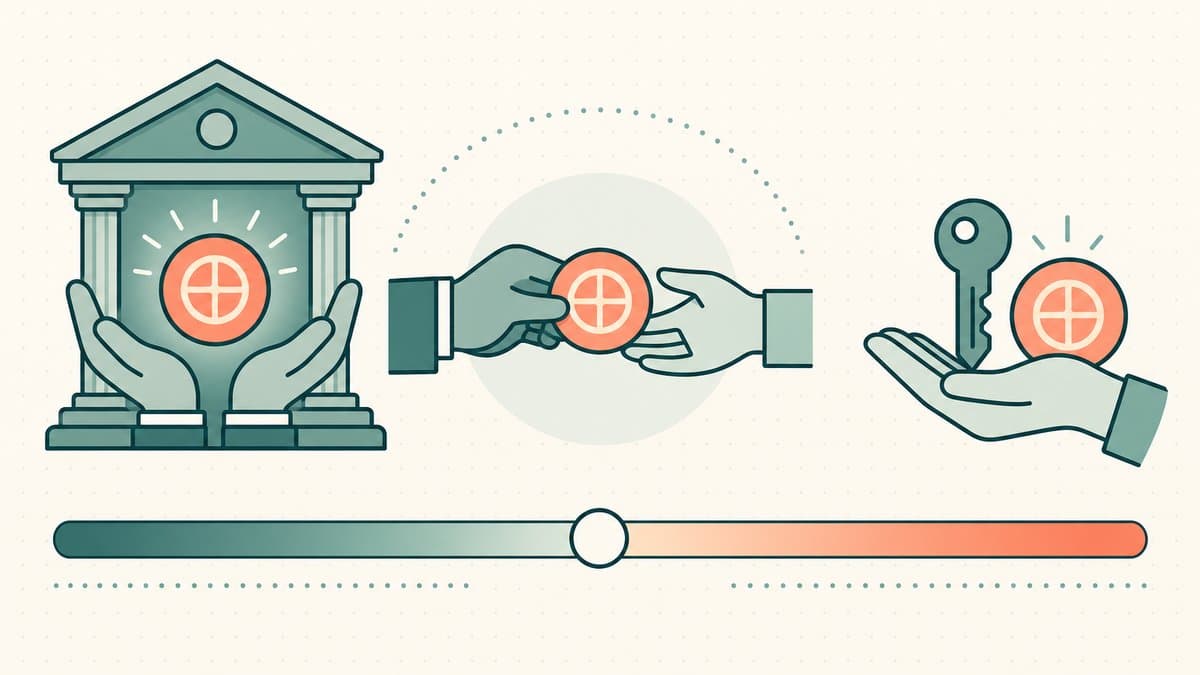
Custody is a spectrum, not a switch. At one end is custodial ownership — a platform or exchange holds the keys and you hold an account login. This can provide an account-recovery path, but it requires trusting the custodian and its controls. At the other end is self-custody: you control the wallet keys and there may be no way to reconstruct a lost private key. Self-custody does not make a tokenized ICANN domain immune to platform contract permissions, ICANN policies, registrar or registry action, dispute procedures, or court orders. Namefi's current terms, for example, reserve operational rights to freeze, mint, and burn domain-related NFTs, and its registration agreement requires implementation of applicable UDRP, URS, and court-order outcomes.
Most serious onchain flippers land in the middle and, crucially, match the custody model to the value and trading frequency of the name. A throwaway name you're actively listing on a marketplace can sit in a hot wallet you sign with daily. A five-figure name you intend to hold has no business living anywhere but cold storage or a multisig. The mistake is treating both the same way — usually by keeping everything in the one MetaMask you also use to mint random NFTs.
Where the keys actually live
A cryptocurrency wallet does not "store" your domain. It stores keys. As Wikipedia puts it, the private key is used by the owner to access and send cryptocurrency and is private to the owner — and the same key authorizes transferring a domain NFT. The practical taxonomy for a domain trader:
- Hot wallets (MetaMask, Rabby) — software wallets connected to the internet. Fine for signing and active listings, exposed to malware, phishing, and malicious signature requests. This is your trading wallet, not your vault.
- Hardware wallets (Ledger, Trezor, Keystone, GridPlus) — keys live on a dedicated device that signs offline. The right home for any name you're holding rather than flipping this week. Move the NFT here after minting.
- Smart-contract wallets (multisig, social recovery) — the keys are governed by onchain logic rather than a single secret. More on these below.
Underneath nearly all of them sits a seed phrase — the 12 or 24 words defined by the BIP-39 specification as a mnemonic for generating a deterministic wallet. That phrase regenerates every key the wallet holds. Per Wikipedia, if the wallet is misplaced, damaged or compromised, the seed phrase can be used to re-access the wallet and associated keys and cryptocurrency. Which is exactly why it's also the single most dangerous string of words you'll ever write down.
Seed-phrase risk is the whole game
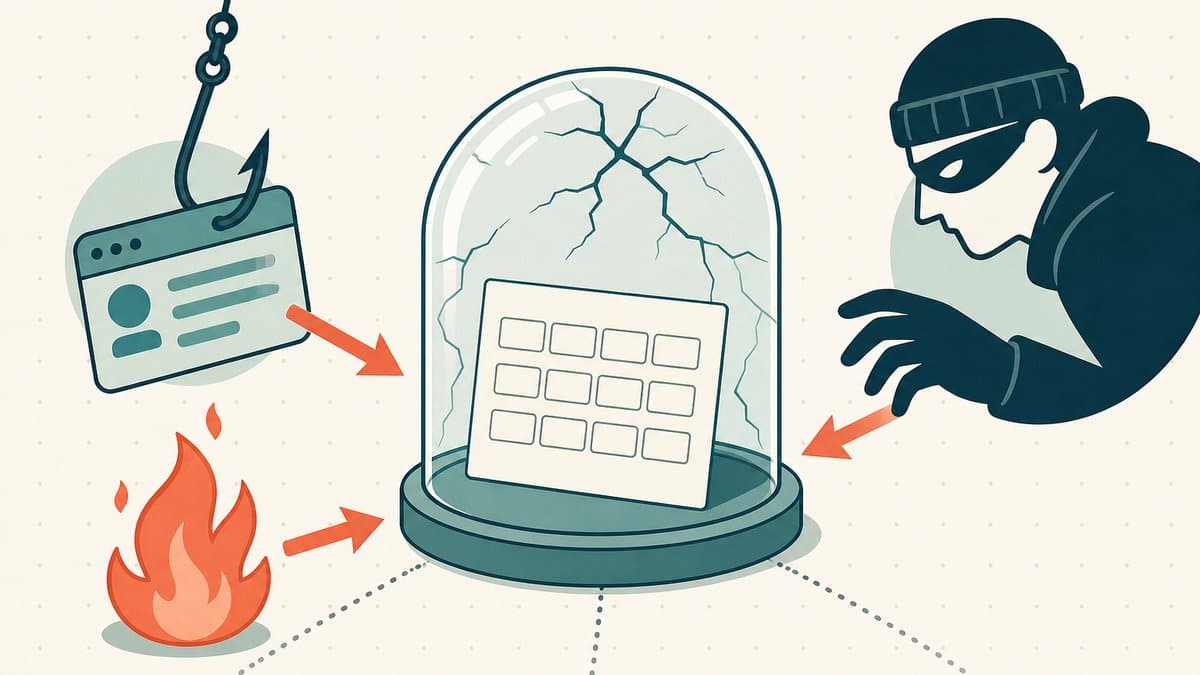
Almost every catastrophic onchain loss reduces to one of two seed-phrase failures, and they pull in opposite directions:
- The seed was stored in only one place, and that place is gone. A phone reset, a fire, a lost notebook. There is no reset link. If the only copy of the words is gone, the name is gone.
- The seed was stored where someone else could read it. A cloud note, a password manager that syncs to the cloud, a photo in your camera roll, a screenshot in a chat, pasted into an LLM. Anyone who reads those words owns everything the wallet controls, instantly and irreversibly.
The defensive posture is boring and non-negotiable. Write the words on paper, twice, in two physical locations; for anything valuable, use a steel backup plate that survives fire and water; never let a real seed phrase touch an internet-connected surface. It's the same discipline experienced flippers apply to renewals: cheap insurance, paid before you need it, against a loss that's total when it lands.
Multisig and social recovery: removing the single point of failure
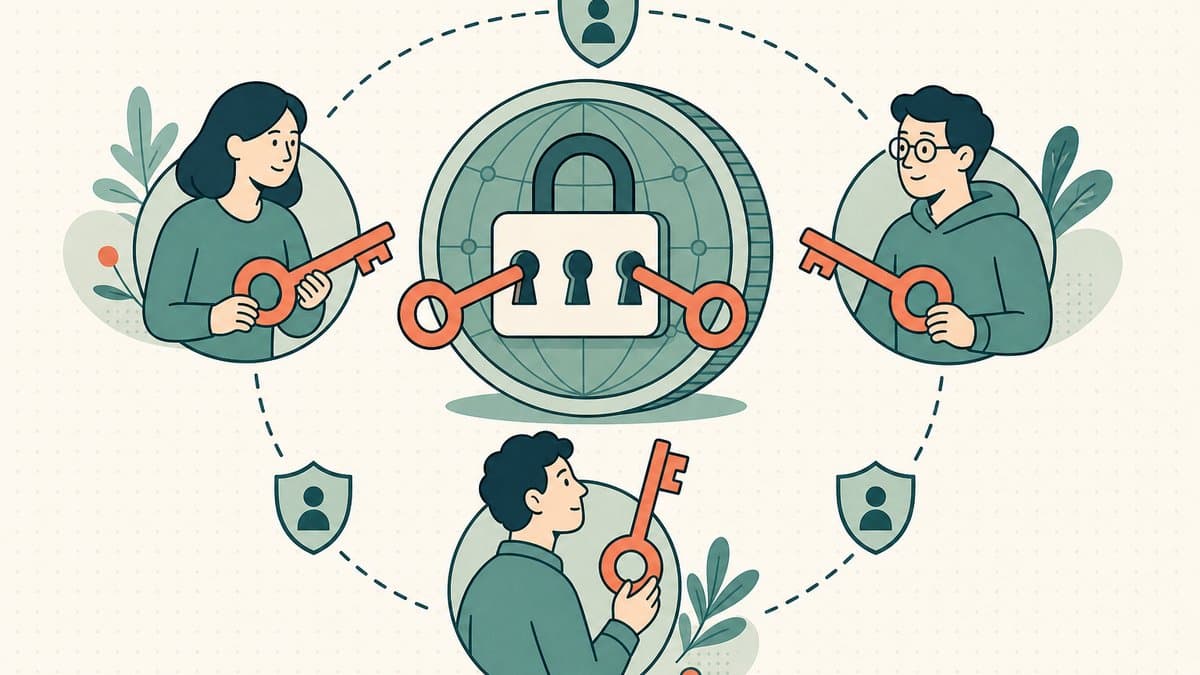
A single seed phrase is a single point of failure. The structural fix is to require more than one key to move the asset.
A multisig wallet — most commonly a Safe (formerly Gnosis Safe) on EVM chains — needs M of N keys to sign before a transfer executes. A 2-of-3 setup spread across a hardware wallet, a co-signer, and a sealed offline backup means losing any one key doesn't lose the domain, and a single phished signature doesn't drain it. The same idea exists in cryptography proper: threshold-signature schemes like FROST, standardized in RFC 9591, let a threshold number of entities cooperate to compute a signature without any one party ever holding the whole key.
But multisig is not a magic word, and treating it as one is how the big losses happen. It defeats single-key compromise and insider risk; it does nothing against a compromised signing UI or a coordinated phishing run that fools several signers on the same bad day. If all three of your "independent" keys live on devices you alone control in the same apartment, you have the overhead of a multisig with the threat model of a single key. We walk through exactly where the protection holds and where it's theater in do multisig wallets actually improve security? — required reading before you trust one with a valuable name.
For solo flippers who don't want to coordinate co-signers, social-recovery wallets (Argent, Safe with a recovery module, ERC-4337 smart accounts) let you nominate guardians who can collectively restore access if you lose your key. Friendlier than a multisig, at the cost of trusting more smart-contract code and a guardian set that has to actually exist and respond.
A practical rule for a trading book: keep a small hot wallet for names you're actively listing, and a multisig or hardware-backed cold wallet for inventory you're holding. Don't make every quick sale require three signers, and don't leave your best name in the wallet you connect to every sketchy mint.
Recovery: what actually happens when access is lost
Prevention is the real recovery strategy, but losses happen, and what's possible depends entirely on how you lost access. The short version:
- Lost the password but have the seed — not really loss. Reinstall, restore from seed, done.
- Lost the device but have the seed — new device, restore from seed, done.
- Have the device but lost the seed — move the NFT to a fresh, properly-backed-up wallet right now, while the device still works.
- Lost both device and seed — the hard case. Cryptographically the token is inaccessible, and nobody can brute-force a private key. Anyone claiming they can is running a scam.
That last case is where the tokenized-ICANN model differs from a pure-onchain name. Because the underlying domain registration also exists off-chain, a platform or registrar may have identity, registration, billing, and WHOIS or RDAP records it can evaluate under its contracts and procedures. That does not create a general right to reverse a token transfer or guarantee recovery after key loss; any available remediation is platform-specific, identity-gated, fact-dependent, and may require legal process. Theft is a different problem from loss: preserve the onchain trail as evidence, notify the platform and relevant marketplaces, and seek qualified legal or law-enforcement help where appropriate.
The full playbook — every loss scenario, the order to act in, and what a platform genuinely can and can't do — is in recovering a tokenized domain after wallet loss. The one-line summary: act fast, preserve evidence, and never assume the door is permanently closed on a real ICANN name.
Custody doesn't pause the renewal clock
One trap that catches flippers new to onchain names: securing the keys perfectly does nothing for the registration. A tokenized domain is still a real domain on a renewal schedule, and the token reflects that state — it doesn't override it. Let the registration lapse and even a flawlessly self-custodied name can expire out from under you.
The onchain-native namespaces work the same way. An ENS .eth name, for example, is rented annually: per ENS, a 5+ letter .eth will cost you 5 USD per year, and after it expires you get a 90-day Grace Period — you can still extend it at the standard price. Nobody else can register it. Tokenized ICANN domains carry the standard registry renewal grace periods of their TLD. Either way, custody and renewal are separate disciplines — owning the key is not the same as keeping the name. Keeping DNS and renewals healthy is part of the same portfolio hygiene that any domain flipping operation lives or dies by.
The Namefi angle
Custody is one place where tokenization changes the operating model for flippers. A Namefi-tokenized domain can be held by a hardware-backed wallet or multisig, so the chosen wallet policy can protect token-authorized ownership actions. That wallet threshold does not automatically govern every DNS, registrar, registry, policy, or legal control plane, and Namefi's terms retain specified operational powers over domain-related NFTs. The off-chain registration record may provide evidence or a platform-specific remediation path when self-custody fails, but recovery is not guaranteed. The practical reason to tokenize a domain is that you can choose a wallet custody model while still accounting for the separate registration and DNS layers. Set each layer up before the name matters.
Friendly Disclaimer (Read Me!)
We're not lawyers, accountants, financial advisors, or doctors, and nothing in this article is legal, financial, tax, accounting, medical, or any other flavor of professional advice. We write these posts to educate ourselves and as a convenience for our customers. Info here may be out of date, geography-specific, or just plain wrong. We make mistakes too.
For any important decision, please consult a real professional (seriously!). Or if that's not your vibe, ask a friend, ask Twitter, ask Reddit, ask an AI, or ask a psychic. In short: DOYR - Do Your Own Research. Let's learn and have fun.
Sources and further reading
- Ethereum — ERC-721 Non-Fungible Token Standard ("a standard interface for non-fungible tokens, also known as deeds")
- Wikipedia — Cryptocurrency wallet (private key control; seed-phrase recovery)
- Bitcoin BIPs — BIP-39 mnemonic code for deterministic wallets
- IETF — RFC 9591: FROST threshold signatures
- Safe — Smart account / multisig infrastructure
- Namefi — Terms of Service (NFT management and ICANN-compliance provisions)
- Namefi — Registration Agreement (UDRP, URS, and court-order procedures)
- ENS Docs — .eth registration pricing (5 USD/year for 5+ letters)
- ENS Support — What is a Grace Period? (90-day post-expiry window)
Contributors

Aileen Wright is a student in her twenties living in New York City, where the distance between a museum wall and a library reading room is a short walk and a long afternoon. She came to name writing through art and history — the way a single portrait, coin, or manuscript margin can carry a name across centuries and change its meaning on the way.
Most weeks you can find her in Central Park with a paperback, or in the quiet of a public reading room chasing down where a name actually comes from rather than what a name-list says it means. She is also teaching herself to code, which has made her oddly precise about spelling, sorting, and the small details that decide whether a name ages well.
For Namefi she writes about the history and culture behind domain names, the stories brands carry as they rename, and the difference between a good story and a verified source.

Victor Zhou is a technology founder and standards editor focused on digital identity and trust. He founded Namefi, edits Ethereum Improvement Proposals, and previously led smart-contract architecture work at Google Labs.
His work sits at the intersection of naming, ownership, and the systems people use to establish identity online. That perspective makes him especially interested in the way names move between personal meaning, public recognition, and digital infrastructure.
For Namefi, Victor edits and writes about domains as durable digital identity: how names become ownable onchain assets, how tokenization changes custody and trust, and what naming can learn from the systems people use to establish identity online.
Related guides
- How Tokenization Changes Domain FlippingHow bringing a domain on-chain can reshape flipping through verifiable token control, compatible marketplaces, and programmable settlement without removing registrar dependencies.
- Appraising ENS and Tokenized Domains: Reading Onchain CompsHow to appraise ENS and tokenized domains using onchain comps, floor-versus-premium reasoning, and ENS club factors — and why it differs from DNS.
- ENS vs DNS Domain Flipping: What's DifferentHow flipping ENS .eth names differs from flipping traditional DNS domains: ownership, liquidity, renewal, gas, and what each is good for.
- ENS vs Unstoppable vs Tokenized DNS DomainsENS vs Unstoppable Domains vs tokenized ICANN DNS, compared on browser resolvability, renewals, and who actually controls the name.