
Selling Domains as NFTs: Onchain Liquidity
How selling a domain as an NFT works: listing mechanics, Seaport and OpenSea, buyer-restricted private sales, royalties, and gas and scam traps.
- domains
- domain-flipping
- web3
- guide

A traditional domain sale has a trust problem baked into it. The seller doesn't want to push the transfer before the money lands; the buyer doesn't want to wire funds before the name shows up in their account. The whole escrow industry exists to stand between those two reflexes. Selling a domain as an NFT changes the token-and-payment leg: a compatible marketplace can settle both atomically, without an escrow agent holding the token between payment and transfer. For a tokenized ICANN domain, registrar, registry, contract, dispute, and legal layers still apply beyond that onchain settlement.
This guide is about that liquidity layer: what actually happens when you list a domain NFT, how the marketplace plumbing works, when to use a buyer-restricted private listing instead of an open one, how royalties behave, and the gas and scam traps that quietly eat into onchain sales. It's a spoke in the broader domain flipping series, and it assumes you already know what a tokenized name is — if not, start with what are tokenized domains.
What you're actually selling
First, a precision point this whole post depends on. A tokenized domain is not the same animal as an ENS name or an Unstoppable name, and selling them is not the same act.
- An ENS
.ethname lives entirely on Ethereum. It resolves through ENS-aware wallets and apps, not in a plain browser address bar, and ENS prices registration by length — per the ENS docs, a5+letter.ethwill cost you5 USDper year, with a4letter160 USDper year and a3letter640 USDper year. - An Unstoppable name (
.crypto,.x, and friends) is a Web3 name minted outside the ICANN root. - A tokenized ICANN domain is the one this series cares about: a real
example.comin the ordinary DNS root, plus a token in your wallet that represents platform-supported control. Registrar and registry records, ICANN policy, platform agreements, disputes, and court orders still matter. We compare the three head-to-head in tokenized domain vs web3 domain.
The marketplace mechanics below can apply where the chain, collection, and venue support the token. But the value and rights transferred differ. When you sell an ENS name, the buyer gets an onchain naming asset under ENS rules. With a tokenized .com, the platform uses the token transfer to update its domain-control layer while ordinary DNS and registration policies remain. Do not assume the two assets have identical rights, support, or demand.
How a domain NFT becomes liquid
Many domain NFTs use ERC-721, the standard Wikipedia describes as a technical framework, defining a set of rules and interfaces for creating and managing unique, non-fungible tokens (NFTs) on the Ethereum blockchain. The standard makes the token technically recognizable; it does not guarantee that every marketplace, wallet, or smart contract supports the chain, collection, listing, escrow, or lending use case.
That standardization can expand the set of compatible venues, but liquidity still depends on marketplace support and buyer demand. That's the structural reason tokenization can change the trade, covered more fully in how tokenization changes domain flipping.
Listing on a marketplace: Seaport and OpenSea
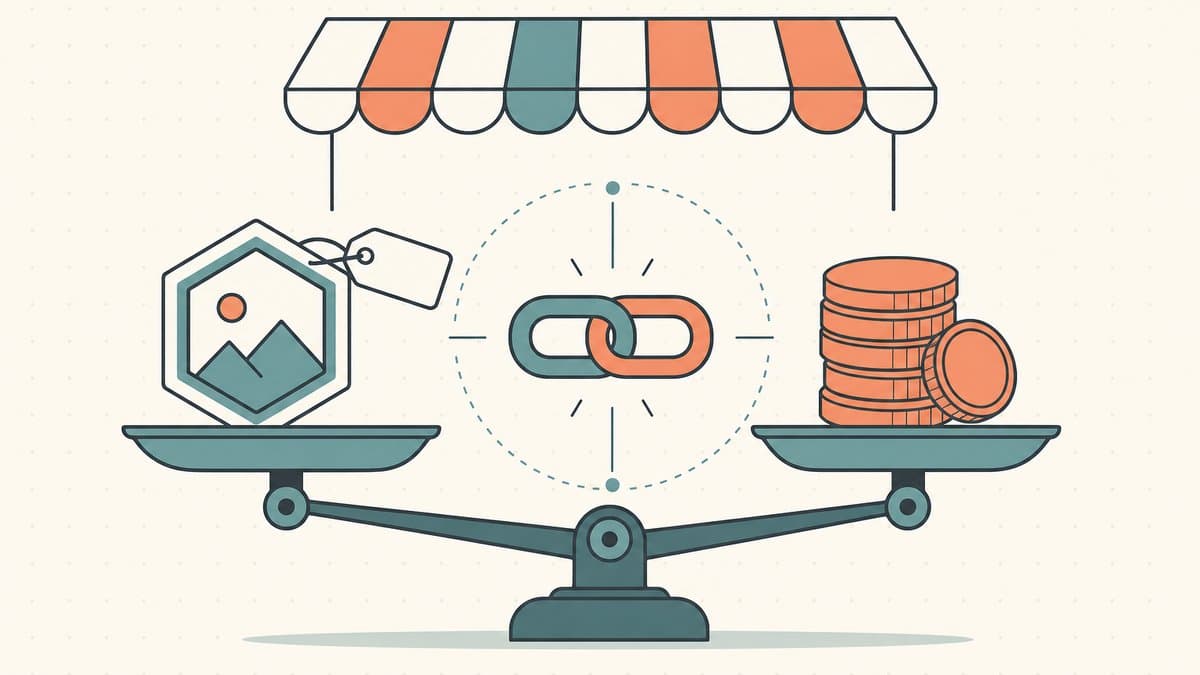
The dominant rails for NFT sales are Seaport and OpenSea, and it helps to understand they're two different layers. Seaport is the protocol; OpenSea is one storefront on top of it. Per OpenSea's own docs, Seaport is a marketplace protocol for safely and efficiently buying and selling NFTs on the blockchain, and Seaport powers the OpenSea website — every order on OpenSea runs through it.
The mental model that matters for a seller is Seaport's two-sided structure: an offer and a consideration. The offer is what you put up (your domain NFT). The consideration is what you require in return (a price in ETH or a stablecoin, plus any fees and royalties routed to other parties). You sign that order once. Nothing moves until a buyer fulfills it, and when they do, the protocol settles both sides in a single atomic step — your token and their payment swap in the same transaction, or neither does. That atomicity is the atomic transfer property that replaces escrow: there is no window where one side has paid and the other hasn't delivered.
Listing in practice is a two-step ritual most sellers do once and then forget:
- Approval. The first time you list from a wallet, you sign an approval letting the marketplace's contract move that token on your behalf when a sale fires. This costs gas; subsequent listings of other tokens in the same collection usually don't.
- The listing order. You sign the actual order — price, currency, duration. Creating a fixed-price listing can be a gasless signature on venues such as OpenSea. Canceling it is different: OpenSea's current help documentation says cancellation requires an onchain transaction and gas fee, including bulk cancellation.
A practical consequence: the buyer, not you, usually pays the gas to execute a fixed-price purchase. OpenSea's seller guide puts it plainly — Buyers pay gas fees when purchasing a fixed-price item, while Sellers pay gas fees when accepting offers. So if you list and wait, the buyer eats the gas; if you actively accept an incoming bid, you do. That asymmetry should shape how you sell when the network is congested.
Buyer-restricted private listings
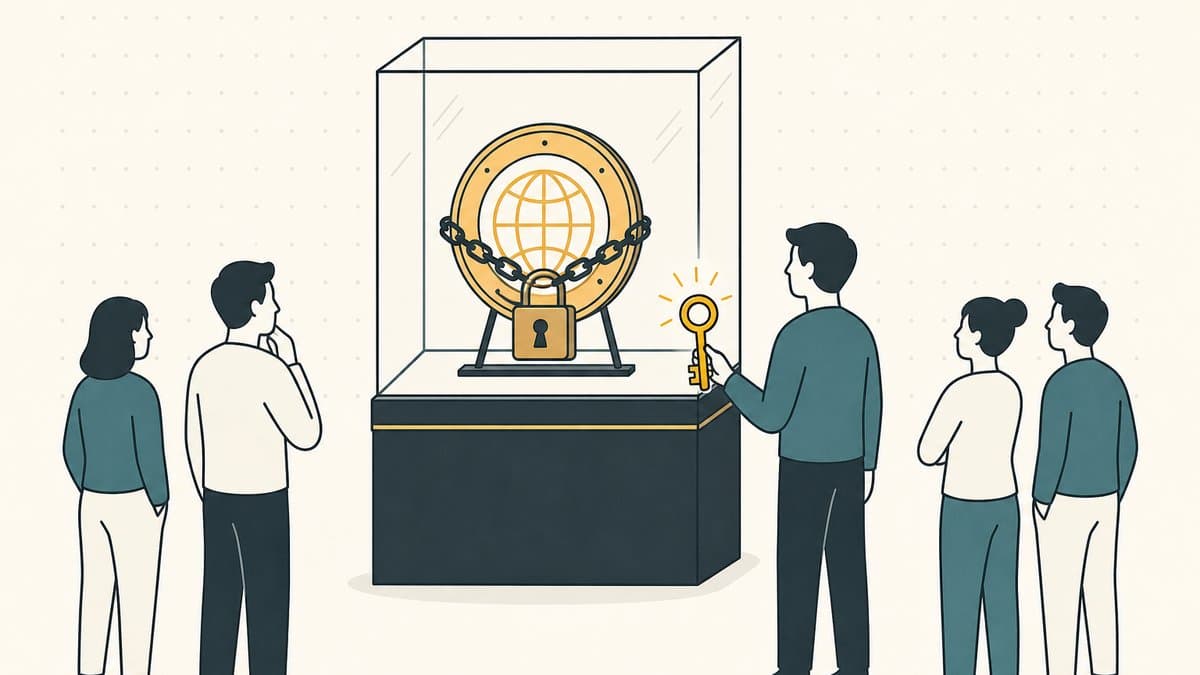
An open listing is fine for a commodity name you'd sell to anyone. But a lot of real domain deals are negotiated off-market first — a price agreed over email or a call — and then you just need a clean, trustless way to settle with that specific buyer. Listing such a name openly is a mistake: a third party watching the marketplace could snipe it at your agreed price before your buyer clicks.
The fix is a buyer-restricted (private) listing. On OpenSea you set this in the listing flow: per its guide, you can reserve the item for a specific buyer. To do so, click Reserve and enter their wallet address. At the Seaport protocol layer, restricted orders rely on the order type and zone validation; the consideration.recipient field instead identifies who receives a consideration item and is not the buyer restriction.
This is the onchain equivalent of a buyer-restricted settlement: negotiate the number with a human, then use a venue's private-listing implementation so the designated buyer can complete the atomic token-and-payment swap. That atomicity applies to the trade legs, not every registrar, contract, dispute, or legal issue. Verify the entire destination wallet address before signing.
Royalties: do they survive the sale?
Some domain NFTs carry a royalty — a percentage routed to the original issuer or a creator on every resale. The standard here is EIP-2981, which exists, in its own words, so that contracts can signal a royalty amount to be paid to the NFT creator or rights holder every time the NFT is sold or re-sold.
Two things every flipper should internalize. First, EIP-2981 only signals a royalty; it doesn't enforce one. Whether the royalty is actually paid depends on the marketplace's policy, and the industry spent 2022–2023 making most royalties optional. Don't model your returns assuming a royalty will be honored on the next hop — it may not be. Second, royalties cut both ways for a flipper: a royalty you pay on the way out is a real cost on your margin, and any platform fee stacks on top. OpenSea's guide notes the storefront typically charges a 1% fee to the seller, and creator earnings, when they apply, come out of your proceeds too. Read the fee breakdown the marketplace shows before you confirm — those are estimates of your take-home, and they're the number that decides whether the flip was worth it.
Gas and scam pitfalls to avoid
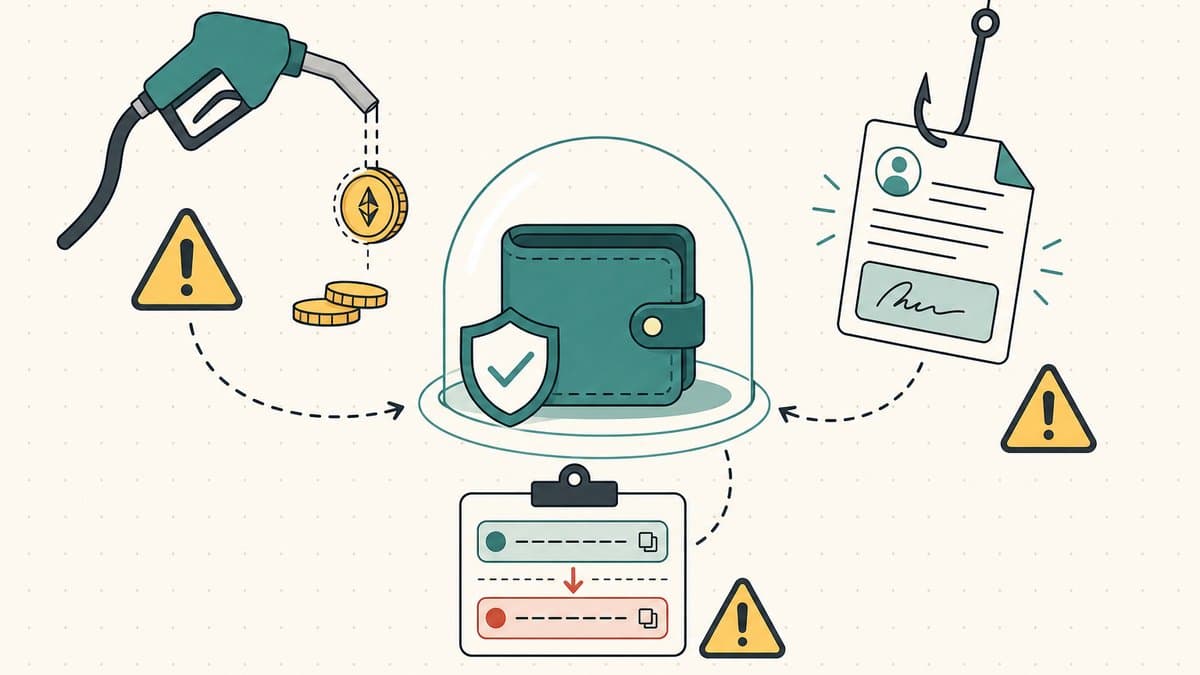
Onchain liquidity is real, but it comes with a new failure surface. The two big ones are gas and fraud.
Gas. Ethereum charges for computation. Per ethereum.org, Gas refers to the unit that measures the amount of computational effort required to execute specific operations on the Ethereum network, and it's paid in ETH. For a four-figure name on a congested day, the approval-plus-settlement gas can be a meaningful slice of your margin — and on a low-value name it can exceed the sale entirely. Two defenses: do your approval when the network is quiet, and consider listing on a lower-fee chain. This is one reason tokenized domains on Base, not just Ethereum mainnet, matter for flippers working smaller names.
Scams. The onchain world has its own con catalog, and domain NFTs are squarely in scope:
- Wallet-address swaps and poisoning. Malware can replace a pasted address, while address-poisoning attacks can deliberately generate a look-alike address with matching first and last characters. Compare the entire address on a trusted hardware-wallet or device screen before signing; at minimum, check multiple groups through the middle, not only the beginning and end.
- Malicious "approval" signatures. A fake marketplace or a phishing site may ask you to sign an approval that grants a contract sweeping power over your tokens. If you don't understand exactly what a signature authorizes, don't sign it. Treat any unexpected approval request as hostile.
- Counterfeit listings. Scammers mint look-alike tokens and list them as if they were the real tokenized domain. Buyers should verify the contract address against the issuer's published one; sellers should make sure their genuine listing is the one buyers find. This is partly why custody and provenance matter — see recovering a tokenized domain after wallet loss and the case for a multi-sig setup in do multi-sig wallets actually improve security.
- Fake "support." Nobody legitimate will DM you first asking for a seed phrase or a "validation" signature. The seed phrase never leaves your control. Full stop.
The throughline: onchain settlement removes counterparty risk from the trade and replaces it with operational risk in your wallet. The escrow agent is gone, and so is the human who used to catch a typo'd transfer. That responsibility is now yours.
Where this leaves a flipper
Selling a domain as an NFT turns a name into something genuinely liquid: an ERC-721 token you can list gaslessly, settle atomically, reserve for a specific buyer, and move across a deep marketplace ecosystem instead of a single registrar's aftermarket. The escrow standoff that defines traditional sales largely dissolves. What it asks in return is onchain literacy — knowing what you're signing, what gas will cost, and which counterparties are real.
For the bigger picture on how tokenized names change the economics of the trade, the hub at domain flipping is the place to start, and why tokenize domains makes the case for adding the onchain layer in the first place. If you want to try a sale end to end on a real, browser-resolvable name, Namefi is built for exactly this — a tokenized .com you can list and settle onchain while the DNS keeps resolving through the handoff.
Friendly Disclaimer (Read Me!)
We're not lawyers, accountants, financial advisors, or doctors, and nothing in this article is legal, financial, tax, accounting, medical, or any other flavor of professional advice. We write these posts to educate ourselves and as a convenience for our customers. Info here may be out of date, geography-specific, or just plain wrong. We make mistakes too.
For any important decision, please consult a real professional (seriously!). Or if that's not your vibe, ask a friend, ask Twitter, ask Reddit, ask an AI, or ask a psychic. In short: DOYR - Do Your Own Research. Let's learn and have fun.
Sources and further reading
- OpenSea Docs — Seaport (marketplace protocol; powers OpenSea; offer/consideration model)
- OpenSea Docs — Seaport models (
ConsiderationItem.recipient, restricted order types, and zone validation) - OpenSea — How to sell NFTs (reserve for a specific buyer; who pays gas; 1% seller fee)
- OpenSea — How can I cancel or lower the price of NFT listings? (cancellation requires an onchain gas fee)
- Wikipedia — ERC-721 (non-fungible token standard on Ethereum)
- Ethereum Improvement Proposals — EIP-2981 (NFT Royalty Standard)
- ENS Docs — .eth registration pricing by length ($5 / $160 / $640 per year)
- MetaMask Support — Address poisoning scams (why checking only the beginning and end is insufficient)
- Ledger Developer Portal — Address verification design guidelines (verify the full address on the secure device screen)
- ethereum.org — Gas and fees (definition of gas)
Contributors

Aileen Wright is a student in her twenties living in New York City, where the distance between a museum wall and a library reading room is a short walk and a long afternoon. She came to name writing through art and history — the way a single portrait, coin, or manuscript margin can carry a name across centuries and change its meaning on the way.
Most weeks you can find her in Central Park with a paperback, or in the quiet of a public reading room chasing down where a name actually comes from rather than what a name-list says it means. She is also teaching herself to code, which has made her oddly precise about spelling, sorting, and the small details that decide whether a name ages well.
For Namefi she writes about the history and culture behind domain names, the stories brands carry as they rename, and the difference between a good story and a verified source.

Victor Zhou is a technology founder and standards editor focused on digital identity and trust. He founded Namefi, edits Ethereum Improvement Proposals, and previously led smart-contract architecture work at Google Labs.
His work sits at the intersection of naming, ownership, and the systems people use to establish identity online. That perspective makes him especially interested in the way names move between personal meaning, public recognition, and digital infrastructure.
For Namefi, Victor edits and writes about domains as durable digital identity: how names become ownable onchain assets, how tokenization changes custody and trust, and what naming can learn from the systems people use to establish identity online.
Related guides
- Onchain Domain Flipping: Trading ENS and Tokenized DomainsHow onchain domain flipping works — trading ENS and tokenized domains through wallets and compatible NFT marketplaces, and how it differs from registrar flipping.
- Tokenize Your .com to Flip It: A Namefi WalkthroughA Namefi walkthrough: add an on-chain token-control layer to a .com, preserve standard DNS, and use atomic payment-and-token settlement without conflating the token with legal title.
- Appraising ENS and Tokenized Domains: Reading Onchain CompsHow to appraise ENS and tokenized domains using onchain comps, floor-versus-premium reasoning, and ENS club factors — and why it differs from DNS.
- ENS vs DNS Domain Flipping: What's DifferentHow flipping ENS .eth names differs from flipping traditional DNS domains: ownership, liquidity, renewal, gas, and what each is good for.