
Tokenize Your .com to Flip It: A Namefi Walkthrough
A Namefi walkthrough: add an on-chain token-control layer to a .com, preserve standard DNS, and use atomic payment-and-token settlement without conflating the token with legal title.
- domains
- domain-flipping
- web3
- guide

Many .com sales have a sequencing problem: the buyer does not want to pay before the agreed control moves, the seller does not want to move it before getting paid, and an escrow service may hold funds while registrar or registrant-change steps complete. Tokenizing the .com adds a token-control layer held in a wallet. A compatible marketplace can exchange that token and the on-chain payment atomically, while any off-chain registrar, registry, contact, policy, and legal steps remain separate and platform-specific.
This is a practical walkthrough of that path on Namefi — add a token layer to an eligible .com, preserve its standard DNS role, then list the NFT where the collection, chain, wallet, and marketplace are supported. It sits inside the broader domain flipping playbook and the on-chain domain flipping pillar. If you want the why before the how, start with why tokenize domains on-chain.
Why flip a tokenized .com instead of a plain one
A traditional .com registrant has contractual rights under the registration agreement and applicable policies. The registrar provides account and operational controls, and the registry maintains authoritative registration state. Selling may involve a registrant change, account push, or inter-registrar transfer, sometimes with escrow bridging the payment and control steps.
Tokenizing adds a token that a compatible wallet can hold. The token uses the ERC-721 interface, which Ethereum's specification defines as a standard API for NFTs within smart contracts. The specification's generic use of the word "deeds" does not make an ERC-721 legal title to an ICANN domain. The token represents a platform-supported control layer; registrant rights still depend on the registration agreement, registrar and registry state, Namefi's terms, and applicable policy and law. That layer can provide three practical capabilities:
- The token and payment can settle together. On a compatible protocol, those two on-chain legs execute together or not at all. Registrar, registry, contact, compliance, and legal steps are not made atomic by ERC-721 or marketplace settlement.
- There may be additional listing venues. A tokenized
.comcan list only where the marketplace supports its chain, collection, token contract, and applicable policies. Listing access does not guarantee buyers or liquidity. - Token history is public. Prior on-chain token transfers are auditable on-chain. They do not, by themselves, prove legal ownership, registrant identity, consideration, off-chain agreements, or every platform intervention.
Tokenization does not move the .com out of public DNS. Unlike a Web3-native suffix such as an ENS .eth, which is outside the ICANN root and needs a supporting client, integration, or gateway, a tokenized .com can use ordinary web, email, and certificate infrastructure after the required DNS, hosting, mail, and CA configuration. That distinction is the whole reason this guide exists; we draw it out fully in what tokenized domains are and tokenized domain vs Web3 domain.
Step 1: Bring the .com on-chain
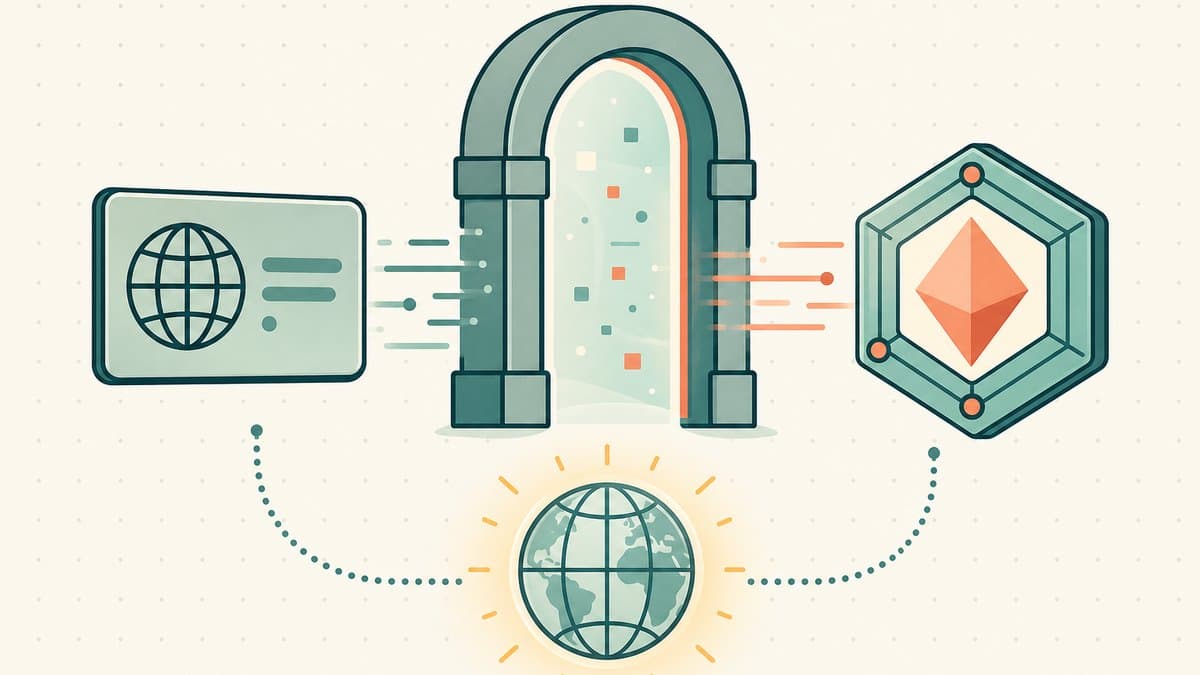
The full screen-by-screen process lives in how to tokenize your .com; here's the shape of it for a flipper.
You connect a self-custodied wallet at namefi.io — that wallet becomes the on-chain holder of the tokenized domain. Token possession is not unconditional legal title and remains subject to the registration agreement, registrar and registry procedures, and Namefi's Terms of Service, which describe platform authority in specified circumstances. You add an eligible .com, and the live product determines the supported registrar and tokenization path. A transfer-in path uses the auth code from the current registrar before minting; availability and required steps should be confirmed in the current interface and agreements.
Two timing notes matter when you're flipping on a deadline. On a transfer-in path, the registrar transfer can take several days under the applicable inter-registrar workflow; other currently supported tokenization paths may not require that transfer, so inspect the live path before estimating a closing date. Recently registered or transferred names can also be inside a transfer-lock window and may be ineligible for a transfer-in path, so check before promising a buyer anything. Where minting is the final step, the wallet confirmation and on-chain inclusion have their own network-dependent timing and gas cost.
When it is done, there are two coordinated layers: off-chain registration and DNS state, and an ERC-721 token-control record in the wallet. How a token transfer is reflected in registrant or registrar state depends on Namefi's current workflow, agreements, policy checks, contact requirements, and any platform intervention; do not assume every underlying right changes atomically merely because the token moved.
Step 2: Custody it like an asset you intend to sell
Wallet security becomes an additional custody layer. A token you plan to hold for months may be safer in a wallet isolated from routine transactions, but the correct setup depends on value, operational needs, recovery design, and the platform's current controls.
A hardware wallet can reduce some hot-wallet exposure. For higher-value names, a multi-sig arrangement trades convenience for protection against a single compromised key, while adding signer and recovery complexity; do multi-sig wallets actually improve security weighs that tradeoff. A lost custodial key can block ordinary token access, but recovery and platform options vary, so plan before you need them; see recovering a tokenized domain after wallet loss. Buyers should reconcile token history with registrar, marketplace, payment, and agreement records rather than treat the wallet history as a complete chain of legal title.
Step 3: Keep DNS resolving through the whole sale

Here's the advantage that separates a tokenized .com from an .eth name, and it's worth protecting deliberately. Tokenizing doesn't change how the domain resolves — nameservers, A records, MX, DNSSEC all keep working, managed from the Namefi dashboard or delegated to your existing DNS provider. We cover exactly what does and doesn't change at DNS on tokenized domains.
For a flipper, DNS continuity should be planned rather than promised. Moving the token does not inherently rewrite nameservers or DNS records, but uninterrupted website, email, and certificate service still depends on the DNS provider, hosting and mail accounts, certificate validation and renewal, platform operations, registrar or registry actions, TTLs, and any changes the buyer makes. Document who will operate each service before and after closing and test the handover path.
Step 4: List it as an NFT
Where supported, you can set a fixed price or open an auction on an NFT marketplace, and the listing is a signed order a qualified buyer can fill. ERC-721 compatibility helps integrations, but each marketplace decides which chains, collections, contracts, wallets, regions, and order types it supports. Availability does not guarantee discovery or liquidity. We walk the listing options in selling domains as NFTs, and compare where to list in on-chain domain marketplaces compared.
You also keep the option of a traditional sales-page funnel for a tokenized name. The difference is purely at the close: the deal settles through a token swap rather than an escrow handoff, which brings us to the payoff.
Step 5: Settle without an escrow standoff

This is where the on-chain plumbing earns its keep. Marketplace protocols built for NFTs let payment and transfer happen atomically — together or not at all. OpenSea's order protocol, Seaport, describes itself as a marketplace protocol for safely and efficiently buying and selling NFTs, and the practical effect is that the buyer's payment and your token transfer swap in one settlement step. No third-party agent holds the asset mid-deal; the contract enforces the swap.
For a tokenized .com, Seaport can make the payment and token legs atomic. The token transfer is not a legal deed or proof that registrar and registry state changed in the same transaction. Namefi's supported workflow coordinates the token with the underlying registration subject to its current agreements, contact and policy checks, registrar and registry procedures, and platform authority. How tokenized marketplaces change escrow explains that narrower trust boundary: the on-chain assets do not move separately, while completion of the domain-control handover may still include off-chain steps and timing.
A realistic look at the economics
Tokenizing doesn't change the underlying math of flipping: it is still a portfolio activity, not a guaranteed return. Many names do not sell. Bringing a name on-chain may add supported listing and settlement options, but it does not guarantee a wider buyer pool, remove every settlement step, or manufacture demand for a name nobody wants. Sober appraisal still matters.
There is also a cost stack to check at the time of the transaction: registrar renewal and transfer charges, network gas, marketplace fees, and any Namefi tokenization or protocol fee shown by the live product. Network and fee comparisons change with conditions, so do not rely on a fixed gas estimate. If the spread between entry price and a realistic sale price does not comfortably clear the full recurring and transaction costs, tokenizing a marginal name may only add steps.
One context point worth keeping in view: the upside on great .coms is real but rare. The record sale remains Voice.com, where per the .nl registry SIDN, blockchain provider Block.one paid 30 million US dollars for the name — still, SIDN notes, the highest publicly disclosed sum ever paid for a domain name. That's an outlier that survives into headlines precisely because it's rare, not a business plan.
Where Namefi fits
Namefi is designed to add a wallet-held token-control layer to supported ICANN domains. Compatible marketplace settlement can atomically exchange the token and payment, while the underlying domain remains subject to registrar and registry state, Namefi's terms, policies, legal controls, and separate service dependencies. Standard DNS can continue to resolve when its providers and configuration remain in place, but continuity is not guaranteed by the token alone. To inspect the current process, start with how to tokenize your .com; to weigh providers first, see choosing a domain tokenization platform.
Friendly Disclaimer (Read Me!)
We're not lawyers, accountants, financial advisors, or doctors, and nothing in this article is legal, financial, tax, accounting, medical, or any other flavor of professional advice. We write these posts to educate ourselves and as a convenience for our customers. Info here may be out of date, geography-specific, or just plain wrong. We make mistakes too.
For any important decision, please consult a real professional (seriously!). Or if that's not your vibe, ask a friend, ask Twitter, ask Reddit, ask an AI, or ask a psychic. In short: DOYR - Do Your Own Research. Let's learn and have fun.
Sources and further reading
- Ethereum Improvement Proposals — ERC-721 Non-Fungible Token Standard ("standard API for NFTs"; NFTs "also known as deeds")
- ProjectOpenSea — Seaport (marketplace protocol for safely and efficiently buying and selling NFTs)
- Namefi — Terms of Service (domain-management NFTs, platform authority, and legal-right limitations)
- SIDN — Voice.com sold for USD 30 million (Block.one, 2019; highest publicly disclosed domain sale)
Contributors

Fenwei Bian is a software developer in her thirties who spends her working hours in pull requests and her weekends with her hands in soil or sawdust. Years of open source on GitHub taught her that names are interfaces: a good one is clear, honest about what it does, and kind to whoever has to use it next.
She gardens because it rewards patience and punishes wishful thinking, and she does woodwork because a joint either fits or it doesn't. Both habits show up in how she writes about naming — measure twice, check the source, and don't sand over a rough spot and hope no one notices.
For Namefi she writes about how domain markets actually move, the practical trade-offs of tokenizing and flipping names, and picking a domain you'll still be glad you own in twenty years.

Victor Zhou is a technology founder and standards editor focused on digital identity and trust. He founded Namefi, edits Ethereum Improvement Proposals, and previously led smart-contract architecture work at Google Labs.
His work sits at the intersection of naming, ownership, and the systems people use to establish identity online. That perspective makes him especially interested in the way names move between personal meaning, public recognition, and digital infrastructure.
For Namefi, Victor edits and writes about domains as durable digital identity: how names become ownable onchain assets, how tokenization changes custody and trust, and what naming can learn from the systems people use to establish identity online.
Related guides
- Onchain Domain Flipping: Trading ENS and Tokenized DomainsHow onchain domain flipping works — trading ENS and tokenized domains through wallets and compatible NFT marketplaces, and how it differs from registrar flipping.
- Selling Domains as NFTs: Onchain LiquidityHow selling a domain as an NFT works: listing mechanics, Seaport and OpenSea, buyer-restricted private sales, royalties, and gas and scam traps.
- Appraising ENS and Tokenized Domains: Reading Onchain CompsHow to appraise ENS and tokenized domains using onchain comps, floor-versus-premium reasoning, and ENS club factors — and why it differs from DNS.
- ENS vs DNS Domain Flipping: What's DifferentHow flipping ENS .eth names differs from flipping traditional DNS domains: ownership, liquidity, renewal, gas, and what each is good for.