
Onchain Domain Flipping: Trading ENS and Tokenized Domains
How onchain domain flipping works — trading ENS and tokenized domains through wallets and compatible NFT marketplaces, and how it differs from registrar flipping.
- domains
- domain-flipping
- web3
- guide

Domain flipping has a familiar shape: buy a name low, find a buyer who needs it, sell high. The classic version of that trade runs through registrars, aftermarket marketplaces, and often an escrow agent who holds the money while the transfer clears. Onchain domain flipping applies that instinct to names represented by a token in a wallet, so the token can trade through compatible NFT infrastructure while the naming system's own rules still apply.
That token layer changes custody, listing, and settlement for the token itself. For a tokenized ICANN domain it does not erase the registrar, registry, contractual, policy, or legal layers behind the registration. This guide explains what onchain domain flipping actually is, draws the important line between two different kinds of "onchain name," and walks the full arc of the trade: acquire, custody, list, settle. It's the onchain pillar of the broader domain flipping playbook.
What "onchain domain flipping" means
In a normal flip, ownership lives in a registrar's database. You log into an account, the registrar's records say you control the name, and moving it to a buyer means an account-to-account or registrar-to-registrar transfer that the registrar mediates. The asset is real, but you never hold it yourself — you hold an account that points at it.
Onchain flipping represents the name as a token. The ERC-721 specification defines a standard API for NFTs within smart contracts. Its summary informally calls NFTs "deeds," but ERC-721 by itself does not establish legal title, registrar rights, or unrestricted control of an ICANN domain. What the token holder controls depends on the naming protocol or tokenization platform, its contracts and terms, and the registrar and registry layers behind a DNS domain. Within that supported system, transferring the token is a smart-contract call rather than an ordinary registrar transfer ticket.
That token interface can let supported onchain names list on compatible NFT marketplaces and settle the token-and-payment legs atomically. Actual settlement time, marketplace support, buyer demand, and liquidity depend on the chain, contract, venue, and market. The chain also provides a public token-transfer history, which is useful evidence but not a complete record of legal ownership or authorization.
Two kinds of onchain name — don't conflate them
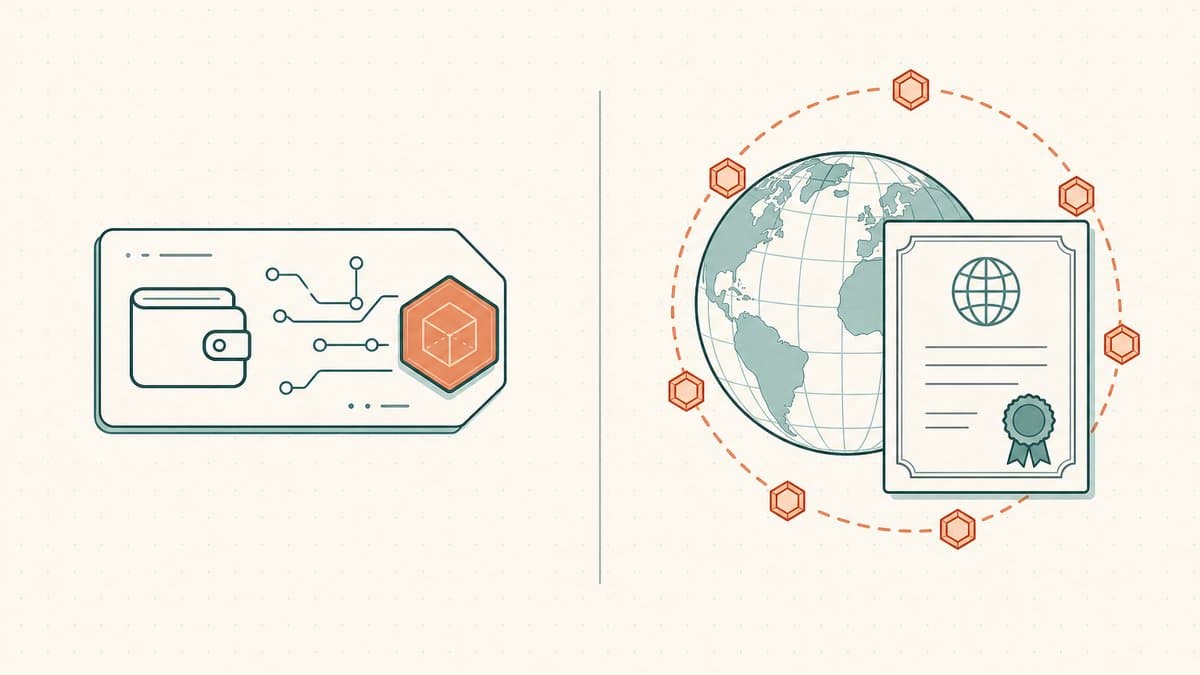
The single most important thing to get right before you trade is that "onchain domain" covers two genuinely different assets that behave differently for a flipper.
The first is the Web3-native name, the archetype being ENS (.eth). These names live entirely on Ethereum. They are not part of the ICANN root, so vitalik.eth does not resolve in an ordinary browser without a resolver or bridge. Their value is as wallet identity and crypto-native naming. ENS is also openly a registration market: per the ENS docs, a 5+ letter .eth will cost you 5 USD per year, with four- and three-letter names priced higher by design, and once registered a name can be moved just like with any other ERC721 token. That low, transparent registration floor is exactly why short, premium .eth names became a speculative market of their own.
The second is the tokenized ICANN domain — a real .com, .xyz, or .io whose platform-supported control is represented by an NFT while the underlying DNS name remains in the ordinary root. As our explainer on what tokenized domains are lays out, these are DNS domains that also have an onchain representation, not a parallel namespace. Registrar and registry records, ICANN policy, platform agreements, dispute procedures, and court orders still apply. For a flipper the distinction is concrete: a tokenized .com retains ordinary DNS resolvability, while an ENS name carries crypto-native utility but needs a resolver or bridge to behave like a conventional website. They can both be traded onchain where supported; they are not the same product.
A third bucket — Web3 TLDs from platforms like Unstoppable Domains — sits closer to ENS than to tokenized ICANN names; the premium Web3 TLDs guide covers where those fit. Keep the three straight and you'll price each correctly.
How it differs from registrar-aftermarket flipping
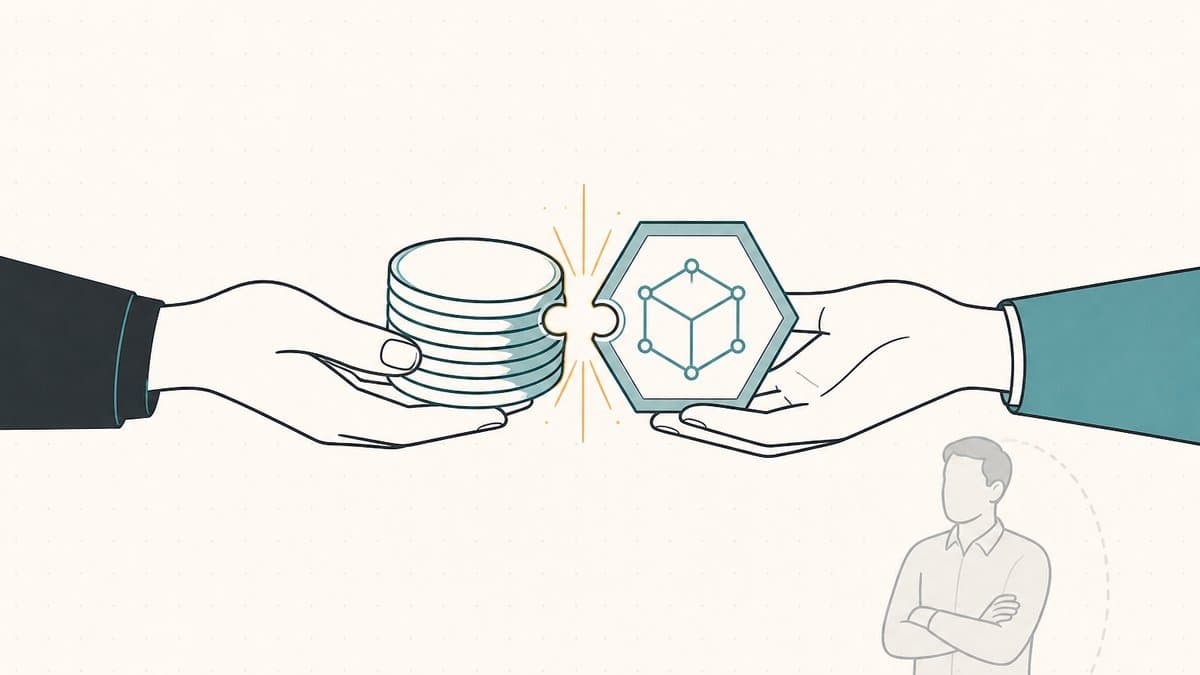
The mechanics diverge most sharply at settlement, which is where traditional flips get nervous. In the registrar world the buyer and seller face a standoff: the seller won't transfer before getting paid, the buyer won't pay before receiving the name, and a third-party escrow agent has to stand in the middle holding both sides. We unpack that classic workflow in domain escrow explained.
Onchain, that standoff can collapse into a single atomic transaction. Marketplace protocols built for NFTs let payment and transfer happen together or not at all. OpenSea's order protocol, Seaport, describes itself as a marketplace protocol for safely and efficiently buying and selling NFTs, and the practical effect is that the buyer's payment and the seller's token swap in one settlement step. No agent holds the asset mid-deal — the contract enforces the swap. That's the mechanism we mean when we say tokenized marketplaces replace escrow.
The other big differences:
- Token custody is yours. The token sits in your wallet, which reduces dependence on an ordinary account login but adds key-management risk. It does not remove platform, registrar, registry, dispute, freeze, or court-order risk.
- Marketplace reach can be broader. A compatible tokenized name may list on general NFT marketplaces as well as domain-specific aftermarkets. That creates more possible venues, not a guarantee of more bids or liquidity.
- Token provenance is public. Onchain transfers and sales are visible, so a buyer can inspect token history without relying only on one marketplace. The chain cannot by itself prove that every transfer was authorized, that a token was not stolen, or that the holder has uncontested legal title.
The trade, step by step: acquire, custody, list, settle
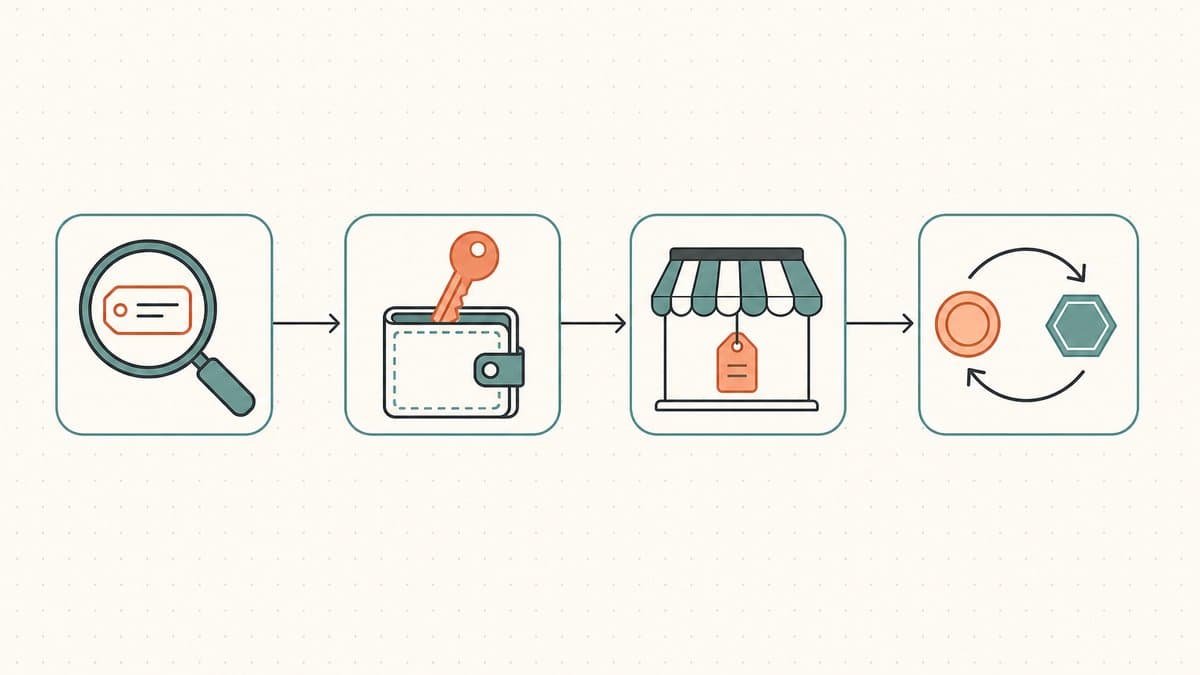
Acquire
You source onchain names the same way you source any flip — looking for mispriced assets — but the channels differ. ENS names come from the ENS registration market or secondary NFT marketplaces; the floor is transparent because anyone can read the registration fee onchain. Tokenized ICANN domains come from registering or tokenizing a real .com you already believe is undervalued, or buying one already tokenized. The discipline is identical to the rest of domain trading: don't fall in love with a name no one will buy, and don't overpay on the way in, because the entry price sets your whole margin.
Custody
This is the step with no equivalent in registrar flipping, and the one new flippers underestimate. Once the name is an NFT, you are the custody system. A hot wallet is convenient for active trading but is the most exposed; a hardware wallet or a multi-sig arrangement trades some convenience for far better protection of a name you're holding for months. Whether multi-sig is the right answer is a real question — we weigh it in do multi-sig wallets actually improve security. And because a lost key can mean a lost name, have a recovery plan before you need one; recovering a tokenized domain after wallet loss covers what's possible and what isn't.
List
Listing an onchain name is a marketplace action, not a "for sale" landing page on a parked domain. You set a fixed buy-now price or open an auction directly on an NFT marketplace, and the listing is itself an onchain (or marketplace-signed) order that any buyer can fill. For tokenized ICANN domains you also keep the option of a normal sales-page funnel — the difference is that the close runs through a token swap rather than an escrow handoff. For tokenized names specifically, DNS continuity matters here: a well-built tokenized domain keeps resolving cleanly through the handover, so a live site doesn't go dark mid-sale.
Settle
Settlement is the payoff for all the onchain plumbing. In a compatible atomic marketplace order, the buyer's payment and the token transfer execute together. For an ENS name, the new holder then controls the .eth token under ENS rules. For a tokenized ICANN domain, a supported platform uses the token transfer to update the onchain control layer and align the domain-management experience; the registrar and registry relationship still follows the platform's agreements and applicable policy. Neither party has to send its trade leg first, and no escrow agent holds the token between them.
What the numbers look like
Onchain flipping is still a portfolio game, not a lottery — most names you hold won't sell, and the wins fund the carry. But the headline sales show why the category gets attention. The most expensive ENS name sold to date, per The Block, was paradigm.eth, which was purchased in October 2021 for 420 ETH (about $1.5 million at the time); the same report notes 000.eth was purchased for 300 ETH ($315,000) in July 2022.
Treat those as outliers, not a business model — the same reality check that applies to .com mega-sales applies double here, with the added wrinkle that onchain name prices ride crypto-market volatility. A floor measured in ETH can halve in dollar terms without a single name changing hands. Sober appraisal, not the highlight reel, is what keeps an onchain portfolio in the black.
Where Namefi fits
Namefi is built to add a wallet-controlled token and compatible marketplace settlement to supported ICANN domains while maintaining ordinary DNS operation. The token-control history is auditable and transferable onchain, subject to Namefi's agreements and the registrar, registry, ICANN, dispute, and legal layers that still govern the underlying registration. Marketplace support and liquidity remain venue- and demand-dependent. If you want to bring a name you already own into this model, the walkthrough is in how to tokenize your .com, and the platform trade-offs are in choosing a domain tokenization platform.
Friendly Disclaimer (Read Me!)
We're not lawyers, accountants, financial advisors, or doctors, and nothing in this article is legal, financial, tax, accounting, medical, or any other flavor of professional advice. We write these posts to educate ourselves and as a convenience for our customers. Info here may be out of date, geography-specific, or just plain wrong. We make mistakes too.
For any important decision, please consult a real professional (seriously!). Or if that's not your vibe, ask a friend, ask Twitter, ask Reddit, ask an AI, or ask a psychic. In short: DOYR - Do Your Own Research. Let's learn and have fun.
Sources and further reading
- Ethereum Improvement Proposals — ERC-721 Non-Fungible Token Standard (NFTs "also known as deeds")
- ENS Documentation — ETH Registrar (registration pricing; transfer as an ERC-721 token)
- ProjectOpenSea — Seaport (marketplace protocol for safely and efficiently buying and selling NFTs)
- The Block — ENS domain 000.eth sells for 300 ETH; paradigm.eth remains the largest ENS sale at 420 ETH
Contributors

Fenwei Bian is a software developer in her thirties who spends her working hours in pull requests and her weekends with her hands in soil or sawdust. Years of open source on GitHub taught her that names are interfaces: a good one is clear, honest about what it does, and kind to whoever has to use it next.
She gardens because it rewards patience and punishes wishful thinking, and she does woodwork because a joint either fits or it doesn't. Both habits show up in how she writes about naming — measure twice, check the source, and don't sand over a rough spot and hope no one notices.
For Namefi she writes about how domain markets actually move, the practical trade-offs of tokenizing and flipping names, and picking a domain you'll still be glad you own in twenty years.

Victor Zhou is a technology founder and standards editor focused on digital identity and trust. He founded Namefi, edits Ethereum Improvement Proposals, and previously led smart-contract architecture work at Google Labs.
His work sits at the intersection of naming, ownership, and the systems people use to establish identity online. That perspective makes him especially interested in the way names move between personal meaning, public recognition, and digital infrastructure.
For Namefi, Victor edits and writes about domains as durable digital identity: how names become ownable onchain assets, how tokenization changes custody and trust, and what naming can learn from the systems people use to establish identity online.
Related guides
- Selling Domains as NFTs: Onchain LiquidityHow selling a domain as an NFT works: listing mechanics, Seaport and OpenSea, buyer-restricted private sales, royalties, and gas and scam traps.
- Tokenize Your .com to Flip It: A Namefi WalkthroughA Namefi walkthrough: add an on-chain token-control layer to a .com, preserve standard DNS, and use atomic payment-and-token settlement without conflating the token with legal title.
- Appraising ENS and Tokenized Domains: Reading Onchain CompsHow to appraise ENS and tokenized domains using onchain comps, floor-versus-premium reasoning, and ENS club factors — and why it differs from DNS.
- ENS vs DNS Domain Flipping: What's DifferentHow flipping ENS .eth names differs from flipping traditional DNS domains: ownership, liquidity, renewal, gas, and what each is good for.