
How to Avoid Domain Sale Scams
The common domain-sale scams — fake escrow, fake buyers, overpayment chargebacks, transfer-before-payment — and the habits that keep your sales safe.
- domains
- security
- domain-flipping
- guide

The money in domain flipping is made when a name finally sells. That is also exactly when scammers show up. A live for-sale listing is an open invitation to anyone willing to impersonate a buyer, a broker, or an escrow company. The single most expensive mistake a flipper can make is not buying the wrong name. It's handing a good name to the wrong person.
Almost every domain-sale scam is a variation on one move: getting you to give up either the domain or the money before the other side has actually delivered. Once you can see that move, the defenses are simple and they barely slow down a legitimate deal. This guide walks the scams you'll actually meet, then the habits that defeat all of them. It's part of the domain flipping skills series, and it pairs closely with the legal side covered in domain flipping and the law.
The one trick behind every scam: who moves first
Every sale between strangers has the same standoff. The buyer doesn't want to pay before they get the domain, and the seller doesn't want to transfer the domain before they get paid. Somebody has to go first, and going first means trusting the other side. That's the whole problem escrow was invented to solve, and we cover the mechanics in domain escrow explained.
Scams are just attacks on that standoff. A scammer's entire goal is to manufacture a reason for you to move first — to transfer the name, send a refund, or pay a "fee" — before any real value has changed hands. Keep that lens on every message you get and the specific tricks below stop being surprising. They're all the same trick wearing different costumes.
Fake escrow sites
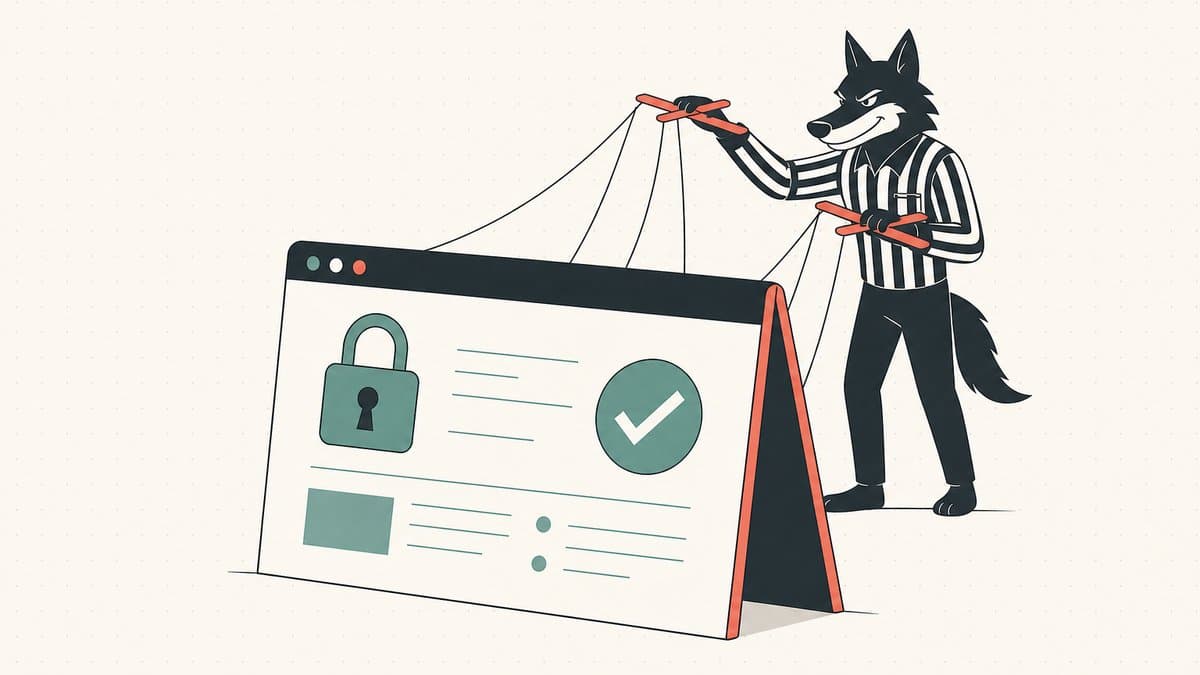
This is the classic, and it's effective because it weaponizes the exact tool you're supposed to trust. A buyer enthusiastically agrees to your price, then insists on using "their" escrow service and sends you a link. The site looks professional. It shows your transaction, your name, the agreed amount, a reassuring "funds received" status. None of it is real.
Wikipedia describes the scheme plainly: the bogus escrow scam is a straightforward confidence trick in which a scammer operates a bogus escrow service. The fake site exists to lie to you at the one moment you're listening hardest. As Wikipedia puts it, this bogus escrow service assures the victim that the scammer has sent its item and that the victim should send its item to the escrow service. You see "buyer has funded escrow," you transfer the domain to settle the deal, and the money was never there. The site goes dark and so does the buyer.
The red flag is not simply who named the escrow service; it is pressure to use a provider or link you have not independently verified. Check the provider's legal identity, licensing where applicable, official domain, and contact details through authoritative sources. California's Department of Financial Protection and Innovation advises users to verify that an online escrow company is licensed and warns that a buyer or seller who insists on a particular service may be steering them to a fraudulent site. Start the transaction by typing the provider's known official domain yourself or by signing in to an account you opened there — never through the counterparty's link — and verify the transaction inside that authenticated account. Escrow.com's own fraud guidance likewise says to go directly to the company's website in your browser rather than clicking a link. A provider suggested by the buyer can be legitimate; the protection comes from independently confirming and using the authentic service.
Fake buyers and fake brokers

Not every scam needs a fake website. Some just need a convincing person. A "buyer" emails with serious interest in a name, name-drops a company, maybe attaches a logo, and moves fast toward a number that's a little too good. The pressure is the product. The goal is to get you emotionally committed to a five-figure sale so that when the "one small step" arrives — pay a transfer fee, cover an escrow deposit, send a refund — you do it without thinking.
A common variant is the fake broker or marketplace agent. You get a message claiming a high-value buyer is ready, but the deal has to run through a specific appraisal service, certification, or "release" fee you pay up front. Legitimate brokers and marketplaces take a commission out of a completed sale. They do not ask the seller to pay money in advance to unlock a buyer who supposedly already exists. Any deal that requires you to pay first to get paid later is the scam, full stop.
These attacks lean on a name looking more legitimate than it is, which is one reason it pays to read ownership records. A quick WHOIS lookup and a search for the company the "buyer" claims to represent will often collapse the story in under a minute. Real buyers survive a Google search. Invented ones don't.
Overpayment and chargeback scams
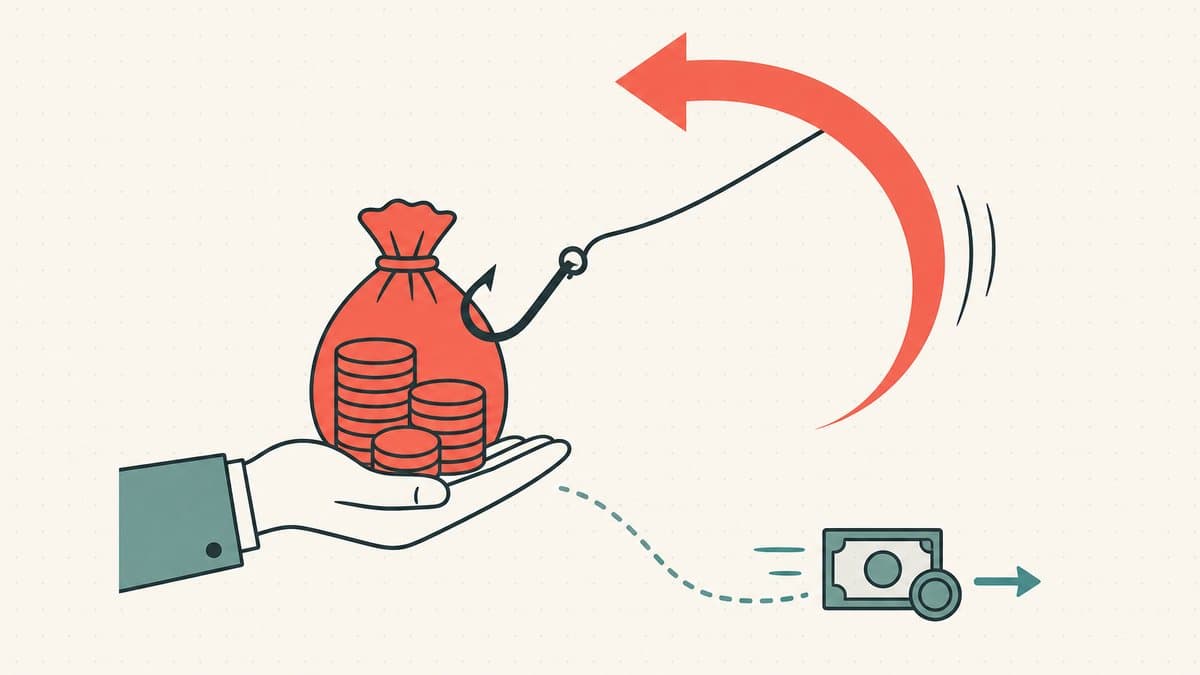
The overpayment scam is older than domains and it adapts perfectly to them. The "buyer" sends a payment for more than the agreed price — a mistake, they say, or an accountant's error — and asks you to refund the difference. You're now staring at money that appears to have landed in your account, so wiring back a few thousand dollars of "their" money feels harmless. Then the original payment is reversed and you're out the refund you sent from your own funds.
The engine here is the chargeback. Wikipedia defines it as a return of money to a payer of a transaction, especially a credit card transaction. Crucially, the chargeback reverses a money transfer from the consumer's bank account, line of credit, or credit card. That reversal can land days or weeks after the payment looked complete, and it's a standard buyer protection that scammers exploit by paying with a stolen or disputable instrument. By the time the chargeback hits, you've already transferred the domain and refunded the "overpayment." You lose both.
The defense is to never act on money that can still be clawed back. A "received" notification is not the same as cleared, irreversible funds, and a refund request on top of a fresh payment is a screaming red flag rather than a courtesy.
Transfer-before-payment
Sometimes the scam skips the theatrics and just appeals to your decency. The "buyer" explains that their company can only pay an invoice after receiving the asset — procurement rules, accounting policy, a boss who needs to see the domain in the account first. Could you transfer it now and they'll release payment immediately? They sound reasonable. They sound almost annoyed that you'd doubt them.
Do not transfer first. Once a domain leaves your control, your leverage is gone, and clawing it back means a slow, uncertain dispute rather than a refund. This matters even more because of how transfers actually work. Moving a domain to another registrar requires an authorization code — ICANN explains that an Auth-Code is required for a domain holder to transfer a domain name from one registrar to another — and once that code is out and the transfer completes, the name is theirs. ICANN's current Transfer Policy still permits denial when a domain is within 60 days of its creation or a previous inter-registrar transfer, and it requires a 60-day inter-registrar lock after a Change of Registrant unless the registrar offered and the registrant chose an opt-out (ICANN Transfer Policy, sections 3.7.5–3.8.5 and II.C.2). Those current 60-day rules were not comprehensively replaced by a universal 30-day lock, and none of them helps you if you've already given the name to a thief.
A close cousin of this scam targets the name you're buying, not selling: the seller takes payment and never releases the auth code, or releases one that doesn't work. The principle is identical from either side. Whoever moves first without a neutral party holding the other half of the deal is the one exposed.
The habits that beat all of them
The scams above are diverse. The defenses are not. A short, boring checklist neutralizes nearly every domain-sale attack, and a legitimate counterparty will happily go along with all of it.
Always use independently verified, escrow-backed settlement. Use a reputable escrow service or marketplace, then independently verify its legal identity, licensing where applicable, and official domain before signing in or funding the deal. Open or join the transaction through the provider's official site and your authenticated account, not a link supplied by either counterparty. A buyer's refusal to use any independently verified neutral service is a reason to stop; merely suggesting a legitimate provider is not proof of fraud. Our full walkthrough of how this should look is in domain escrow explained and the seller's checklist in how to sell a domain name you own.
Verify the other side before you trust the deal. Run a WHOIS lookup, check the company the buyer claims to be, confirm email domains match, and be suspicious of free webmail addresses pretending to be corporate procurement. A two-minute identity check defuses the fake-buyer and fake-broker scams almost entirely.
Never transfer first, and never act on uncleared money. Don't release the domain or the auth code until escrow confirms real, irreversible payment. Don't refund an "overpayment." Don't treat a "funds received" screen as proof of anything. Time is always on the honest party's side, so let the clock run.
Never pay an up-front fee to unlock a sale. Legitimate brokers and marketplaces are paid out of a completed transaction. A demand for advance fees, "appraisals," or "release" payments to access a buyer is the scam itself.
Slow down when urgency spikes. Pressure, flattery, and a deal that's slightly too good are the scammer's core tools, because they all push you to skip the steps above. The more a buyer rushes you, the more carefully you should move.
If a name is valuable enough to attract a scammer, it's valuable enough to sell properly. The point of these habits isn't paranoia. It's that you get to keep the upside you worked for instead of donating it to someone with a convincing email.
The Namefi angle
Most of this guide is about defending the moment of handover — proving payment is real before the name moves, and proving the name is real before the money moves. That whole standoff exists because, in the traditional system, ownership and payment live in two separate places that have to be reconciled by a trusted middleman.
Namefi narrows that gap by tokenizing ownership of real ICANN domains, making control of the name auditable while preserving DNS continuity through a handover. Token transfer alone, however, is not atomic payment-versus-ownership settlement: ERC-721's standard transfer functions specify moving NFT ownership from one address to another, not a required purchase-payment leg. If both legs are onchain, a specific sale contract can bind payment and ownership delivery in one transaction and revert if either leg fails; EIP-140 specifies that REVERT stops execution and rolls back all state changes made so far. That contract-level binding — not tokenization by itself — is what creates atomic delivery-versus-payment and reduces the "who moves first" problem. Without it, the parties still need escrow or another settlement mechanism. We dig into that shift in how tokenized marketplaces replace escrow.
Friendly Disclaimer (Read Me!)
We're not lawyers, accountants, financial advisors, or doctors, and nothing in this article is legal, financial, tax, accounting, medical, or any other flavor of professional advice. We write these posts to educate ourselves and as a convenience for our customers. Info here may be out of date, geography-specific, or just plain wrong. We make mistakes too.
For any important decision, please consult a real professional (seriously!). Or if that's not your vibe, ask a friend, ask Twitter, ask Reddit, ask an AI, or ask a psychic. In short: DOYR - Do Your Own Research. Let's learn and have fun.
Sources and further reading
- Wikipedia — Bogus escrow (definition and mechanics of the fake-escrow scam)
- Wikipedia — Chargeback (definition and how a chargeback reverses a payment)
- ICANN — Transfer Policy · Registrant transfer FAQ
- Ethereum Improvement Proposals — ERC-721 token-transfer semantics · EIP-140 transaction rollback semantics
- California DFPI — 10 Tips to Avoid Online Escrow Fraud
- Escrow.com — Fraud Prevention
- Namefi resources — Domain escrow explained · How to sell a domain name you own · How domain hijacking actually happens
Contributors

Aileen Wright is a student in her twenties living in New York City, where the distance between a museum wall and a library reading room is a short walk and a long afternoon. She came to name writing through art and history — the way a single portrait, coin, or manuscript margin can carry a name across centuries and change its meaning on the way.
Most weeks you can find her in Central Park with a paperback, or in the quiet of a public reading room chasing down where a name actually comes from rather than what a name-list says it means. She is also teaching herself to code, which has made her oddly precise about spelling, sorting, and the small details that decide whether a name ages well.
For Namefi she writes about the history and culture behind domain names, the stories brands carry as they rename, and the difference between a good story and a verified source.

Victor Zhou is a technology founder and standards editor focused on digital identity and trust. He founded Namefi, edits Ethereum Improvement Proposals, and previously led smart-contract architecture work at Google Labs.
His work sits at the intersection of naming, ownership, and the systems people use to establish identity online. That perspective makes him especially interested in the way names move between personal meaning, public recognition, and digital infrastructure.
For Namefi, Victor edits and writes about domains as durable digital identity: how names become ownable onchain assets, how tokenization changes custody and trust, and what naming can learn from the systems people use to establish identity online.
Related guides
- Onchain Domain Flipping: Trading ENS and Tokenized DomainsHow onchain domain flipping works — trading ENS and tokenized domains through wallets and compatible NFT marketplaces, and how it differs from registrar flipping.
- Selling Domains as NFTs: Onchain LiquidityHow selling a domain as an NFT works: listing mechanics, Seaport and OpenSea, buyer-restricted private sales, royalties, and gas and scam traps.
- Tokenize Your .com to Flip It: A Namefi WalkthroughA Namefi walkthrough: add an on-chain token-control layer to a .com, preserve standard DNS, and use atomic payment-and-token settlement without conflating the token with legal title.
- Cybersquatting vs Legitimate Domaining: UDRP and ACPA ExplainedWhere legitimate domaining ends and cybersquatting begins: the UDRP three-part test, the ACPA, reverse domain hijacking, and how to stay safe.