
How to Sell Domains for Profit
The end-to-end playbook for selling domains: inbound vs outbound, pricing format, where to list, when to use a broker, and closing the deal safely.
- domains
- domain-investing
- domain-flipping
- guide

A domain you can't sell is just a renewal bill with a clever name on it. Buying well and appraising honestly are upstream skills; this is the one where the money actually arrives. Most of the profit in flipping is made or lost at the selling stage, because a mediocre name sold well beats a great name nobody can find. This is the selling pillar of our guide to domain flipping — the end-to-end arc from "I own this name" to "the funds cleared." We'll cover the two ways buyers reach you, how to set a price format, where to list, when a broker earns their cut, and how to close without getting scammed. For a step-by-step checklist of a single sale, pair this with how to sell a domain name you own.
Inbound vs outbound: the two roads to a buyer

Every domain sale starts one of two ways, and knowing which game you're playing changes everything downstream.
Inbound means you make the name discoverable and wait for a prospective buyer to come to you. A for-sale landing page, a listing on a marketplace, a price visible to anyone who types the name into their browser. Inbound can require less direct outreach, but timing, buyer budget, and eventual margin vary widely. An inquiry shows interest, not a guaranteed willingness to pay your preferred end-user price.
Outbound means you identify a possible buyer and reach out first. It requires active prospecting, and its timing and results are uncertain. Outreach that targets a trademark holder can become relevant to a UDRP bad-faith analysis, while untargeted bulk messages may violate applicable anti-spam rules or platform policies. Use narrowly researched, legally reviewed outreach rather than assuming volume will improve the result.
Some sellers combine both channels: inbound can capture existing interest, while carefully selected outbound can put a name in front of prospects who had not seen the listing. Neither channel guarantees demand or a sale. We compare the two approaches in depth in inbound vs outbound domain sales.
Set the price format before the price
Before you argue with yourself about the number, decide how the number is presented, because the format shapes who engages and how the negotiation runs.
- Buy It Now puts a fixed asking price on the name and can let a buyer transact without negotiating. The tradeoff is that the listed price caps that transaction even if a particular buyer might have accepted more.
- Make Offer invites negotiation and can reveal information about a buyer's position. It also adds steps, and an offer may be far below the seller's expectation or may never lead to a completed deal.
There's no universally right answer; the choice depends on the name, your patience, and whether you're optimizing for transaction speed or retaining room to negotiate. Pricing also has a psychological layer — anchoring, round numbers, and the signal a price sends about the intended buyer. We unpack that in domain pricing psychology: buy now vs make offer. Whatever you choose, remember the end-user vs reseller distinction: investors and businesses may value the same name differently, but neither category guarantees a particular spread.
Where to sell: marketplaces, parking, and your own page
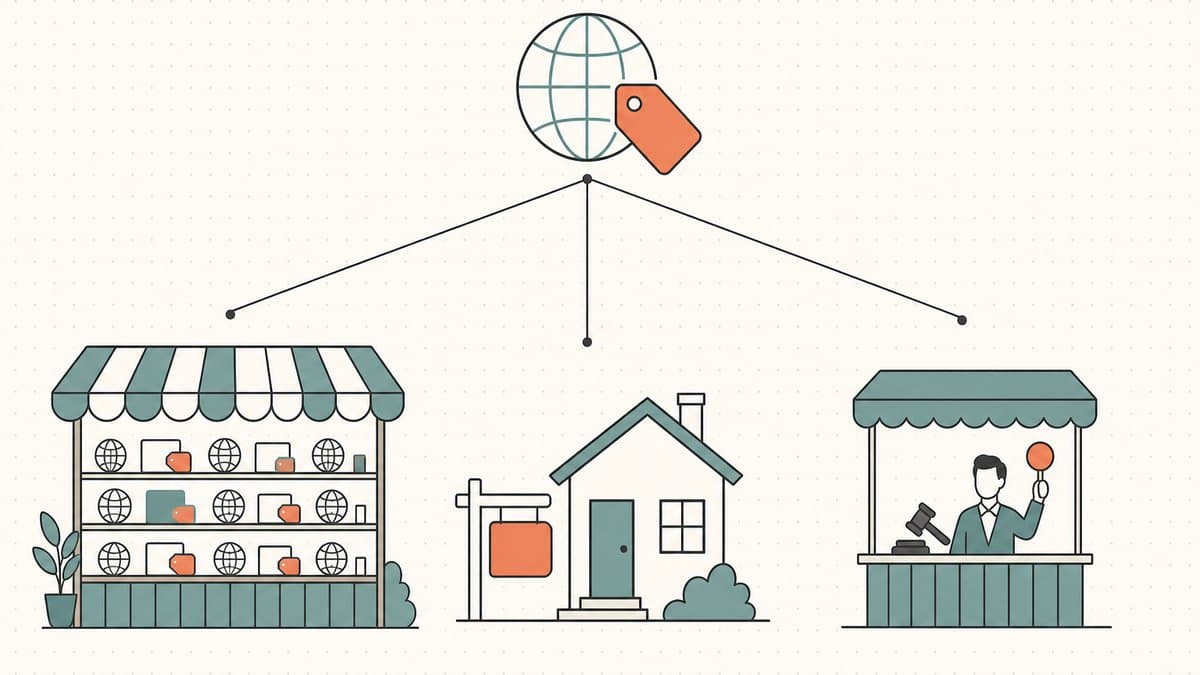
Inbound demand has to land somewhere. The domain aftermarket exists precisely for this. Wikipedia defines it as the secondary resale market for Internet domain names in which a party interested in acquiring a domain that is already registered bids or negotiates a price to effect the transfer. It's a real, active market: per Wikipedia, according to NameBio, 144,700 domain name sales totaling US$185 million were recorded in 2024 — and that's only the disclosed slice.
Your main venues:
- Aftermarket marketplaces. These connect buyers and sellers and handle the transaction plumbing. Wikipedia notes that aftermarket transactions are facilitated by aftermarket platforms such as Afternic and Sedo, which provide communication methods for buyers and sellers to interact, often anonymously, to negotiate and close a transaction. Sedo is, in Wikipedia's words, an American domain aftermarket company. Marketplaces give you reach and built-in trust at the cost of a commission.
- A for-sale landing page. Parking the name on a page that says "this domain is for sale" gives a direct visitor a clear way to contact the seller or transact.
- Auctions. For names with multiple interested bidders, an auction creates a competitive process. It can raise the final price, but it can also close below a seller's expectation if the audience or reserve is poorly chosen.
Each venue trades reach, fees, and control differently. We line up the big ones side by side in where to sell domains: marketplaces compared. Wherever you list, the listing lives in the broader marketplace layer of domain trading, and the same fundamentals from how to value a domain name decide whether anyone bites.
When to bring in a broker
For a name whose expected sale economics and negotiation complexity justify professional help, a broker may be worth considering. Relevant benefits can include buyer relationships, negotiating distance, confidential outreach, and help coordinating pricing, escrow, and transfer logistics. Those benefits depend on the broker, mandate, buyer pool, and transaction.
The tradeoff is the fee and the loss of some direct control. Compare the broker's terms and likely contribution with the expected transaction value rather than relying on a universal price threshold. We cover how to choose one and what to expect in working with domain brokers.
Closing the deal without getting scammed
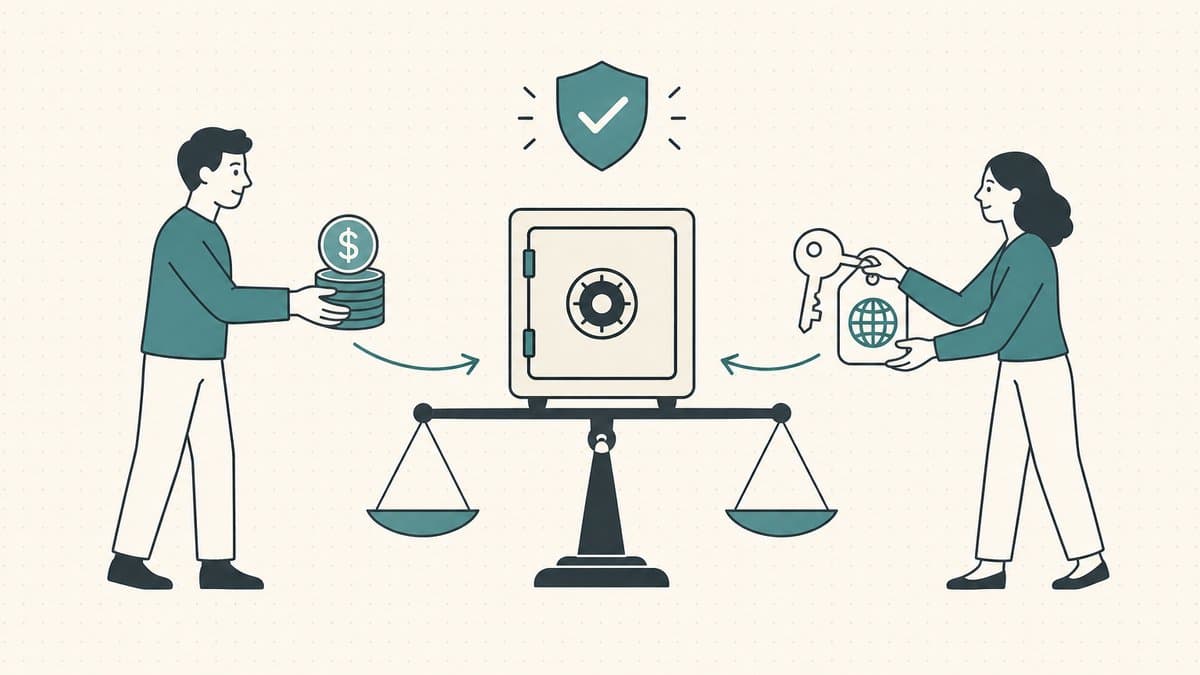
This is the stage where real money is on the table and trust is at its thinnest. The classic standoff: the seller doesn't want to transfer the name before getting paid, and the buyer doesn't want to pay before receiving the name. Neither wants to move first.
The standard answer is escrow — a neutral third party that holds the money until the name changes hands. Wikipedia defines escrow as a contractual arrangement in which a third party ... receives and disburses money or property for the primary transacting parties, with the disbursement dependent on conditions agreed to by the transacting parties. In a domain deal, the buyer funds escrow, the seller transfers the name, the escrow agent confirms the transfer, and only then does the money release. We walk through the full mechanism in domain escrow explained and in the escrow glossary entry.
The transfer itself has mechanics worth knowing before you promise a buyer anything. A domain name transfer is, per Wikipedia, the process of changing the designated registrar of a domain name. To move a name between registrars, the gaining registrar normally needs the authentication code, also called an EPP code. Under ICANN's Transfer Policy, the registrar of record may deny another inter-registrar transfer within 60 days of a previous one, subject to limited exceptions. That restriction is distinct from an account change or registrar-specific internal push, so confirm the exact transfer path and status before promising a date. For a deeper map of how transfers go wrong on purpose, our piece on how domain hijacking actually happens is the cautionary read.
A few closing controls: choose an escrow or settlement method proportionate to the value and counterparty risk, verify funds according to that method's rules before releasing control, and plan WHOIS or RDAP and DNS continuity through the handover. Do not treat a message or screenshot as settled payment.
Don't sell a name you can't legally sell
One closing caution belongs before, not after, the sale: a label such as "generic," "descriptive," or "invented" is not a legal safe harbor. The USPTO explains that invented or fanciful words can be among the strongest trademarks, while the UDRP assessment turns on the particular mark, domain, rights or legitimate interests, registration, use, and intent. A trademark owner must establish all three UDRP elements, including that the domain was registered and used in bad faith. WIPO's current panel overview says registering domains for resale is not itself bad faith and that an offer to sell is not by itself evidence of bad faith when the registrant has an independent right or legitimate interest; targeting a trademark owner is fact-specific. Before outbound outreach, evaluate trademark risk and obtain qualified legal advice where the facts are uncertain. For the full framework see what is UDRP.
A realistic word on the numbers
The headline sales are real but rare. In February 2026, broker GetYourDomain.com announced the $70 million sale of AI.com, more than double the previous public record of $30 million for Voice.com. AI.com's launch announcement says the domain was acquired in 2025 in a transaction believed to be the largest domain purchase in history. Public lists still provide useful historical context: Wikipedia records Voice.com's 2019 sale for $30,000,000 and Sex.com's 2010 sale for $13,000,000, while noting that its list is limited to pure domain name and cash-only sales of $3 million or more. These are category-defining .coms sold to unusually motivated buyers — not a normal flipping business model.
For the rest of us, selling is a percentages game. As an industry rule of thumb (an estimate, not a measured statistic), the share of a hand-registered portfolio that sells in a given year runs low, often in the low single digits. The math works because the price of the rare sale is so skewed: one good four- or five-figure deal funds the renewals on many names that go nowhere. That's why selling discipline — the right format, the right venue, clean outreach, a safe close — is the lever that actually moves your returns. Pricing the .com against the .io, .ai, or .co version of the same word, and knowing which buyer you're selling to, is the difference between a listing and a sale.
The Namefi angle
Most of this guide is about finding the buyer. The other half of every sale is handing over the asset, including the seller-transfers-first versus buyer-pays-first standoff that escrow is designed to manage. Namefi represents control of a real ICANN domain through tokenized ownership and provides domain-management and outbound-discovery tools. A supported marketplace transaction can make the payment and token-transfer legs atomic, but registrar records, DNS, platform rules, and any post-sale claim steps still need to be verified for the specific transaction. If you're curious where the model can reduce some settlement steps—and where it cannot—see how tokenized marketplaces replace escrow.
Friendly Disclaimer (Read Me!)
We're not lawyers, accountants, financial advisors, or doctors, and nothing in this article is legal, financial, tax, accounting, medical, or any other flavor of professional advice. We write these posts to educate ourselves and as a convenience for our customers. Info here may be out of date, geography-specific, or just plain wrong. We make mistakes too.
For any important decision, please consult a real professional (seriously!). Or if that's not your vibe, ask a friend, ask Twitter, ask Reddit, ask an AI, or ask a psychic. In short: DOYR - Do Your Own Research. Let's learn and have fun.
Sources and further reading
- Wikipedia — Domain aftermarket (definition; NameBio 2024 sales volume; Afternic and Sedo as facilitators)
- Wikipedia — Sedo (American domain aftermarket company)
- Wikipedia — Escrow (definition of escrow)
- Wikipedia — Domain name transfer (transfer process, authentication/EPP code, 60-day re-transfer lock)
- Wikipedia — Uniform Domain-Name Dispute-Resolution Policy (the three elements of a UDRP claim)
- USPTO — Strong trademarks (fanciful or invented words can be strong marks)
- WIPO — Overview of WIPO Panel Views on Select UDRP Questions, section 3.1.1 (resale, targeting, offers to sell, and fact-specific bad-faith analysis)
- GetYourDomain.com via PR Newswire — AI.com sale announced at $70M
- AI.com — 2026 launch announcement (domain acquired in 2025)
- Wikipedia — List of most expensive domain names (Voice.com $30M/2019, Sex.com $13M/2010; $3M+ cash-only scope)
Contributors

Fenwei Bian is a software developer in her thirties who spends her working hours in pull requests and her weekends with her hands in soil or sawdust. Years of open source on GitHub taught her that names are interfaces: a good one is clear, honest about what it does, and kind to whoever has to use it next.
She gardens because it rewards patience and punishes wishful thinking, and she does woodwork because a joint either fits or it doesn't. Both habits show up in how she writes about naming — measure twice, check the source, and don't sand over a rough spot and hope no one notices.
For Namefi she writes about how domain markets actually move, the practical trade-offs of tokenizing and flipping names, and picking a domain you'll still be glad you own in twenty years.

Victor Zhou is a technology founder and standards editor focused on digital identity and trust. He founded Namefi, edits Ethereum Improvement Proposals, and previously led smart-contract architecture work at Google Labs.
His work sits at the intersection of naming, ownership, and the systems people use to establish identity online. That perspective makes him especially interested in the way names move between personal meaning, public recognition, and digital infrastructure.
For Namefi, Victor edits and writes about domains as durable digital identity: how names become ownable onchain assets, how tokenization changes custody and trust, and what naming can learn from the systems people use to establish identity online.
Related guides
- For-Sale Landing Pages That ConvertHow to build a domain for-sale landing page that converts: a clear price or offer path, real trust signals, and a frictionless way to buy or make an offer.
- Running a Domain Portfolio Like a BusinessRun your domains like inventory: track cost basis, watch sell-through rate, control renewal drag, prune losers, and keep the books clean.
- Domain Pricing Psychology: Buy-Now vs Make-OfferHow listing mode and initial numbers can influence a domain sale: anchoring, when to name a price, planned concessions, and buy-now vs make-offer.
- Hand-Registering Domains to Flip: Finding Available GemsHow to find still-available domains worth a registration fee: wordlists, TLD permutations, brandable patterns, and the filters that beat impulse buys.