
Inbound vs Outbound Domain Sales
Inbound vs outbound domain sales: when each works, the effort-and-return tradeoff, and how to run both without your outreach reading as spam.
- domains
- domain-investing
- domain-flipping
- explainer

Domain-sales conversations often begin in one of two directions: a prospective buyer finds the listing, or the seller contacts a prospective buyer. Inbound includes direct navigation, a for-sale page, a marketplace inquiry, or another buyer-initiated contact. Outbound means the seller initiates a targeted conversation. Pricing format, marketplace choice, brokerage, and settlement can affect either channel.
Some sellers use only inbound listings; others add selective outbound research. Neither approach guarantees a sale, and the right mix depends on the name, legal risk, buyer fit, price, and the seller's time. This explainer sits under our domain flipping series as a companion to the how to sell domains for profit playbook. It defines each channel, compares effort and uncertainty, and offers a name-by-name decision framework.
Inbound: make the name findable and let the buyer come

Inbound selling means making a name discoverable and allowing a prospective buyer to initiate contact. The mechanics can include a for-sale landing page, a listing on an aftermarket marketplace, and a Buy It Now or Make Offer path. Those surfaces still require monitoring: prices and availability can drift across venues, inquiries need responses, and a sale elsewhere can make a stale listing dangerous.
An aftermarket gives registered domains a place to be listed, searched, negotiated, and transferred. Platforms such as Afternic and Sedo may also distribute eligible listings through registrar partners. That infrastructure can expose a listing to buyers, but it does not make every domain liquid and does not reveal whether a disclosed transaction began as inbound, outbound, or brokered contact.
What you get from inbound:
- Potential access to end users. A buyer who already wants the name may value it differently from a reseller, but an inbound inquiry does not prove buyer type, budget, or willingness to pay. See end-user vs reseller pricing.
- Lower per-prospect effort. A listing can serve many potential buyers without separate research for each one, although it still needs accurate pricing, availability, contact, and transfer settings.
- No unsolicited-message risk. The buyer initiates the contact. That reduces outreach and spam concerns, but it does not remove trademark or cybersquatting risk arising from the registration, use, parking content, or sale target.
Inbound gives the seller little control over timing. Portfolio sell-through rate varies by inventory quality, price, extension, venue, measurement method, and period; a generic industry estimate should not be treated as a forecast for a particular portfolio. The renewal-cost-vs-sell-through calculation therefore needs the seller's own sourced data and explicit assumptions. Even a strong name may never receive an acceptable offer.
The craft of inbound is reducing avoidable confusion when a buyer does come. That means a clear for-sale landing page, accurate listings in suitable venues from where to sell domains: marketplaces compared, and an intentional price format. The Buy It Now vs Make Offer decision shapes how an incoming buyer can engage.
Outbound: find the buyer and reach out first
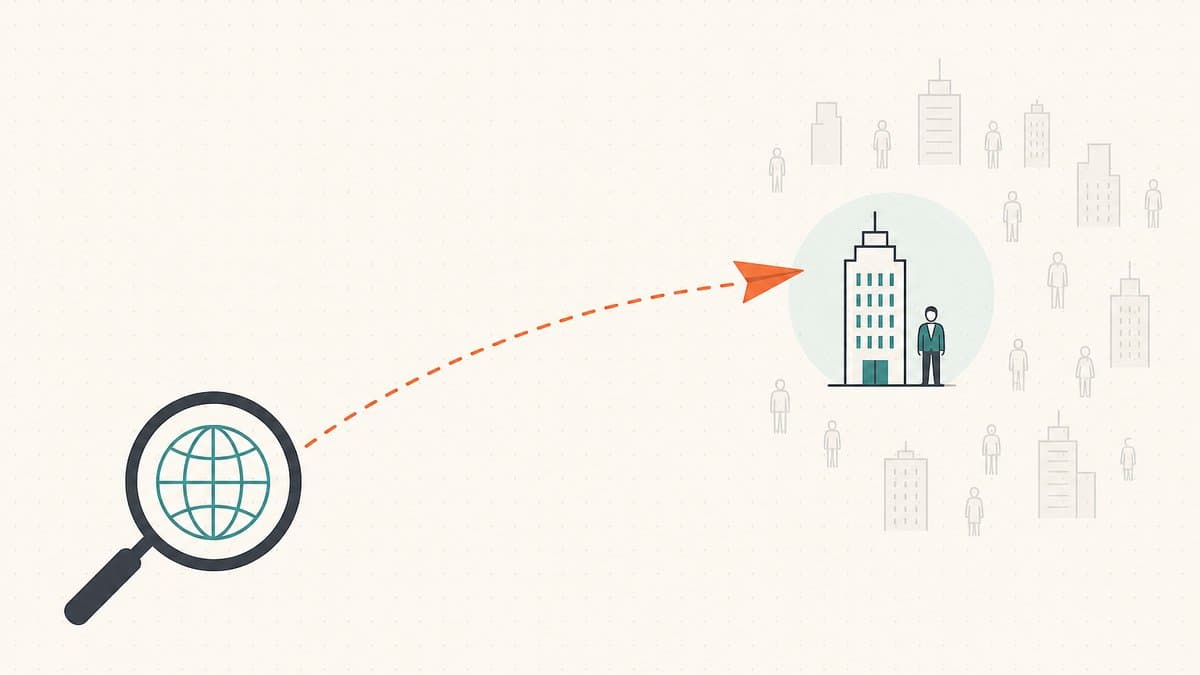
Outbound flips the direction. Instead of waiting, you identify the company, person, or project that would obviously benefit from a name you hold, find the right contact, and start the conversation yourself. It's how you sell a name whose ideal buyer would never think to search an aftermarket — because they don't know your name exists, or don't know it's for sale.
Domain investing is commonly described as acquiring domain names with the intent of reselling them, although outcomes can include a profit, a loss, or no sale. Outbound is the seller-initiated version of testing whether a particular prospect sees enough legitimate value to begin a conversation.
Outbound can help because:
- It can shorten discovery. A well-researched message can reach a relevant prospect without waiting for that prospect to encounter a listing. Response and closing time remain unpredictable.
- It reaches people outside marketplace search. A regional business, startup, or organization may not be browsing an aftermarket. Targeted outreach is one way—not the only way—to make availability known. The move from teslamotors.com to tesla.com illustrates why some organizations value an upgrade; it does not show that unsolicited outreach caused that transaction or predict another buyer's price.
- It tests a specific use-case hypothesis. A response may provide evidence that the name fits a real buyer. Silence does not prove the name has no value, and interest does not guarantee a transaction.
The cost of outbound is effort and risk. Researching a plausible buyer, finding an appropriate contact, following applicable messaging and privacy rules, and writing a relevant message takes time. High-volume, poorly targeted outreach can become spam. Trademark screening is also essential, but generic, descriptive, or invented is not a complete safety test: the USPTO explains that fanciful (invented), arbitrary, and suggestive terms can be strong marks, while a term may be descriptive or generic only in relation to particular goods or services.
Under ICANN's UDRP, a complainant must prove all three policy elements: trademark rights and confusing similarity, the registrant's lack of rights or legitimate interests, and registration and use in bad faith. WIPO's current Overview says domain resale for profit and an offer to sell are not, by themselves, proof of bad faith where the registrant has an independent right or legitimate interest. The analysis is fact-specific. Targeting a distinctive mark, registering primarily to sell to the mark owner, patterns of abusive registration, confusing content, and the registrant's explanation can all matter. Inbound contact does not cure a targeting problem, and outbound contact can become evidence when the surrounding facts show targeting. Screen the name, registration history, use, parking content, and proposed recipient; obtain qualified legal advice when risk is material. The fuller framework is in what is UDRP.
Done right, outbound is one well-researched message to one buyer with a real need. That single email beats a thousand blasts, and it's the difference between a salesperson and a nuisance.
The effort-and-return tradeoff

Lay the two side by side and the tradeoff is clean.
| Inbound | Outbound | |
|---|---|---|
| Who moves first | Buyer | You |
| Timing | Buyer-initiated and unpredictable | Seller can initiate; response remains unpredictable |
| Effort per prospect | Shared listing and monitoring effort | Individual research and outreach effort |
| Scales by | Portfolio size and listings | Your time and judgment |
| Main risk | No acceptable inquiry; stale listings; trademark risk still applies | No response; spam/privacy rules; evidence of trademark targeting |
| Buyer signal | Buyer has initiated contact | Seller hypothesizes buyer fit |
Inbound is reusable infrastructure: one accurate listing can serve multiple prospective buyers. It is not cost-free because the seller still pays renewals, monitors inquiries, and keeps listing details synchronized. Its weakness is that the seller cannot schedule demand.
Outbound is labor: careful outreach is a custom research task. It lets the seller choose which hypotheses to test, but it cannot force interest, timing, price, or a sale.
The channels are not necessarily either/or. One reasonable model is to keep accurate inbound listings for eligible inventory and reserve outbound for names with a credible, legally screened use-case and a small set of relevant prospects. That is a workflow choice, not a universal rule or a marker of whether a seller is "serious."
How to decide name by name
You don't choose inbound or outbound for your portfolio. You choose it for each name. A few questions sort it fast:
- Can you identify a plausible use case and recipient without relying on their mark? A real fit supports further research; it does not mean the recipient "obviously" needs the name.
- Does the expected, evidence-based upside justify the work? There is no universal price threshold. Compare research and compliance cost with your own sourced valuation range and probability assumptions, or consider a broker.
- What does a trademark and history screen show? Search relevant jurisdictions and classes, review how the domain has been used, and look for facts suggesting a particular rights holder was targeted. Do not assume an invented or dictionary term is automatically safe.
- What is your timing constraint? Outbound lets you initiate contact, but it cannot guarantee a quick sale. Inbound may produce no inquiry or an unacceptable offer.
For some names, the channels can run in parallel: maintain an accurate inbound listing while conducting limited, screened outreach. That does not mathematically double the chance of sale and may add legal, operational, or stale-listing risk. For the mechanics after a buyer engages—pricing, settlement, and transfer—pair this with how to sell a domain name you own.
The Namefi angle
Whichever road brings the buyer, the deal still has to close, and closing is where high-value trades get nervous. The standoff is the same on both channels: the seller won't transfer before getting paid, the buyer won't pay before receiving the name, and neither wants to move first. That friction is exactly why escrow exists, and it gets sharper the more a name is worth — which is to say, sharper on precisely the names you'd run outbound for.
This is one boundary Namefi is designed to address. For supported domains and transactions, tokenized ownership can provide an auditable representation of control and enable atomic payment-and-token transfer. Registrar records, DNS, platform terms, legal rights, and any buyer claim or withdrawal steps remain separate boundaries to verify. A settlement mechanism does not make an outreach message lawful, prove buyer fit, or guarantee conversion. If a Namefi Outbound service is used, confirm its current scope, eligibility, fees, and process before relying on it.
Friendly Disclaimer (Read Me!)
We're not lawyers, accountants, financial advisors, or doctors, and nothing in this article is legal, financial, tax, accounting, medical, or any other flavor of professional advice. We write these posts to educate ourselves and as a convenience for our customers. Info here may be out of date, geography-specific, or just plain wrong. We make mistakes too.
For any important decision, please consult a real professional (seriously!). Or if that's not your vibe, ask a friend, ask Twitter, ask Reddit, ask an AI, or ask a psychic. In short: DOYR - Do Your Own Research. Let's learn and have fun.
Sources and further reading
- Wikipedia — Domain aftermarket (definition)
- Wikipedia — Domain name speculation (definition of domaining)
- ICANN — Uniform Domain-Name Dispute-Resolution Policy
- WIPO — WIPO Overview 3.1: UDRP bad faith, resale, and offers to sell
- USPTO — Strong trademarks: fanciful, arbitrary, suggestive, descriptive, and generic terms
Contributors

Aileen Wright is a student in her twenties living in New York City, where the distance between a museum wall and a library reading room is a short walk and a long afternoon. She came to name writing through art and history — the way a single portrait, coin, or manuscript margin can carry a name across centuries and change its meaning on the way.
Most weeks you can find her in Central Park with a paperback, or in the quiet of a public reading room chasing down where a name actually comes from rather than what a name-list says it means. She is also teaching herself to code, which has made her oddly precise about spelling, sorting, and the small details that decide whether a name ages well.
For Namefi she writes about the history and culture behind domain names, the stories brands carry as they rename, and the difference between a good story and a verified source.

Victor Zhou is a technology founder and standards editor focused on digital identity and trust. He founded Namefi, edits Ethereum Improvement Proposals, and previously led smart-contract architecture work at Google Labs.
His work sits at the intersection of naming, ownership, and the systems people use to establish identity online. That perspective makes him especially interested in the way names move between personal meaning, public recognition, and digital infrastructure.
For Namefi, Victor edits and writes about domains as durable digital identity: how names become ownable onchain assets, how tokenization changes custody and trust, and what naming can learn from the systems people use to establish identity online.
Related guides
- Domain Backorders and Drop-Catching, ExplainedWhat domain backorders and drop-catching are, how services race to grab a name the instant it releases, and when a backorder is worth paying for.
- What Is Domain Parking? Parked Domains and MonetizationLearn what a parked domain is, why people park domains, and how parking, sale landing pages, and monetization differ.
- End-User Price vs Reseller Price: Why One Domain Has Two NumbersWhy a domain has a low wholesale/reseller price and a much higher end-user price, how big the spread is, and which number applies to your sale.
- Expired Domains and the Drop Cycle, ExplainedHow a domain expires and drops: grace period, the 30-day redemption window, 5-day pending delete, release — and where dropped names surface for flippers.