Expired Domains and the Drop Cycle, Explained
Separate registrar deadlines from registry deletion: understand redemption, pending delete, expired auctions and drop catching without a false countdown.


- domains
- domain-investing
- domain-flipping
- explainer
An expired domain is not automatically available to buy. The registrar controls customer renewal deadlines and may offer an expired-domain auction. The registry controls deletion and release. Confusing those two processes can cost an owner a domain or send a buyer to the wrong marketplace.
This guide uses ordinary .com registrations as the concrete example. Country-code domains and sponsored extensions can follow different rules. Check the exact extension and registrar before using any timeline.
The expiration date does not start a universal countdown
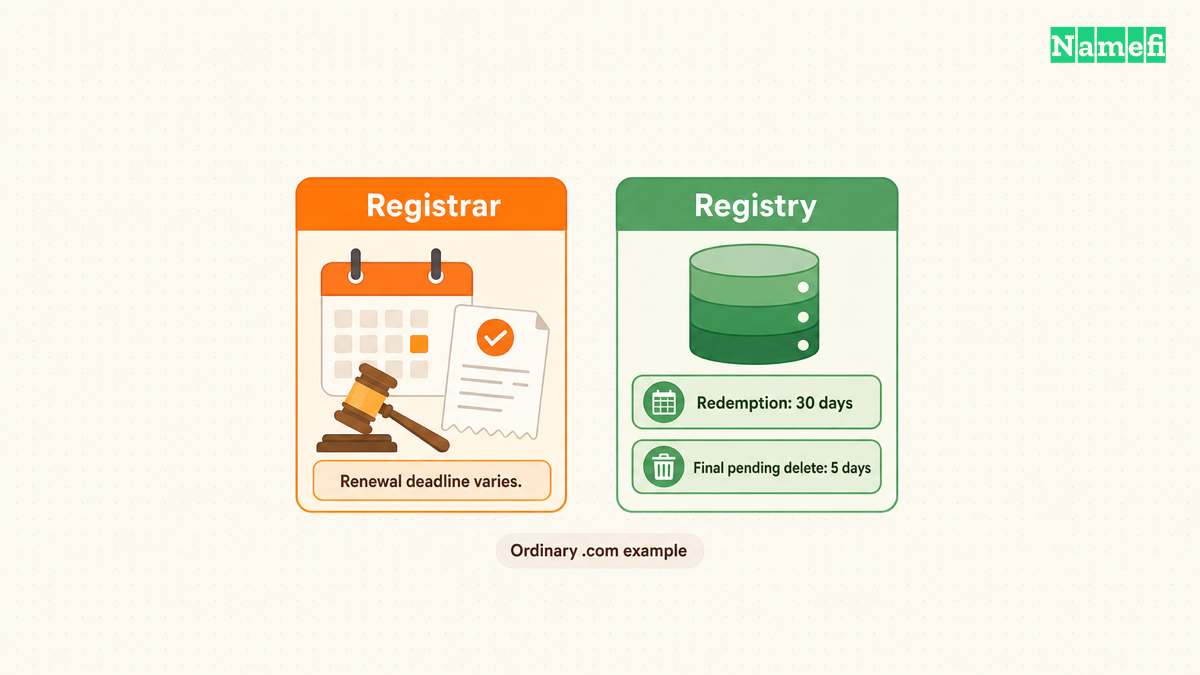
A registration has a limited term. Renewal extends that term. For .com, the registry can automatically add a year after expiration even when the customer has not paid the registrar. The registry gives the registrar 45 calendar days to delete that auto-renewed registration and obtain the applicable registry credit. That accounting window does not guarantee the customer 45 days to renew. See Appendix 7, section 3.1.3 of the current .com registry agreement.
Consequently, a registry expiration date that moved forward does not prove that the customer paid. Compare the registration data with the registrar account and renewal receipt.
ICANN's current recovery policy, section 2.2, permits registrars to delete expired registrations subject to applicable rules. The policy also protects renewal during the required DNS interruption period. It does not establish one deletion day for every registrar.
| Event or state | What the timing means | What the reader should do |
|---|---|---|
| Customer expiration | The paid registration term ends | Ask the registrar about renewal immediately |
.com auto-renew grace | The registry provides a 45-day accounting window to the registrar | Do not treat 45 days as a customer entitlement |
redemptionPeriod | The ordinary .com deletion process provides 30 calendar days for restoration | Ask the deleting registrar for restoration and the total fee |
Final pendingDelete | The ordinary .com process provides five calendar days after unsuccessful redemption | Check the full status combination and the registry release process |
| Release | The registry purges the registration | Check actual availability and any acquisition service terms |
The .com periods come from Appendix 7, sections 3.1.3, 3.1.6 and 3.3.2. Adding 45 + 30 + 5 does not produce a guaranteed release date after customer expiration. The registrar can delete earlier, renew the registration, or use an auction process instead of letting the name drop.
The registrar sets its customer recovery and auction process
Registrar timelines can give useful dates when the reader knows the provider. For example, GoDaddy's standard expiration timeline lists parking at day +5 and an expired auction at day +26. Recovery eligibility changes with bids and purchases. GoDaddy also lists extension exceptions and says it cannot advise when the registry will release a domain.
Those dates describe GoDaddy's standard process. They do not describe every registrar or every extension. An auction listing does not prove that the registry deleted the registration. A domain sold before deletion can change registrants without ever becoming publicly available.
For an owner, contact the registrar now rather than waiting for a supposed final grace day. Check the account, renewal notices, payment method and quoted recovery fee. ICANN requires registrars to disclose renewal, post-expiration and restoration fees in its recovery policy, section 4.
Redemption starts after deletion rather than automatically after expiration

For ordinary .com deletion outside the add-grace period, the registry sets redemptionPeriod for 30 calendar days. The registry removes the name from its zone. The deleting registrar can request restoration. ICANN’s registrant FAQ explains the recovery process.
ICANN requires a 30-day redemption period for nonsponsored gTLD registries, with an exception for deletions during the registry add-grace period. During redemption, the registry disables DNS resolution and generally prohibits registrar transfers. The original registrant requests recovery through the deleting registrar under recovery policy section 3.
A registrar can charge a restoration fee. There is no universal $100 customer price. Ask for the total restoration and renewal cost. A buyer cannot register the name while the registry retains the registration in redemption.
The full status combination determines whether redemption remains possible
A status lookup needs more than the words pendingDelete. ICANN's status guide explains that pendingDelete can appear with redemptionPeriod or pendingRestore. In those combinations, the redemption or restoration description applies.
For ordinary .com registrations that complete redemption without restoration, the final pending-delete period lasts five calendar days. The registry rejects registrar modification requests during that period. The registry then purges the registration. ICANN’s registrant FAQ also describes this five-day stage.
A public status and expiration date alone do not establish an exact release hour. Confirm the extension, full status set and acquisition provider's current handling. Do not promise a buyer that a particular name will become available on a calculated date.
Buyers must distinguish an expired auction from a drop catch

An expired auction can sell a registration before deletion. A drop catch attempts a new registration after release. A backorder requests an acquisition attempt under the provider's terms. None of those labels guarantees delivery.
Multiple services cannot each complete the same new registration at release. A successful provider can, however, run an auction when several customers want the name. For example, Dynadot's current backorder policy sends a successfully caught name with multiple backorders to a public auction. Private participation is not a universal rule.
Check the auction type, eligibility, payment obligations and cancellation terms before placing an order. The separate backorder and drop-catching guide covers acquisition mechanics. The auction guide covers bidding decisions.
A watchlist must record the acquisition channel and the name's history

Use drop lists to find candidates, then verify each candidate's current state. Record the registrar, extension, observed statuses, observation time, potential auction venue and backorder deadline. A database label such as “expired” is a lead rather than proof of availability.
Before buying, inspect prior website use, trademarks, link quality and the complete acquisition cost. A registration history does not guarantee useful traffic or valuable backlinks. The domain-flipping guide explains the wider valuation task, while hand registration offers another sourcing route.
Keep renewal control after acquisition. A later marketplace listing or token transfer does not remove the underlying registration's renewal requirements. Check the registrar's renewal responsibility and recovery procedure before relying on any resale arrangement.
Friendly Disclaimer (Read Me!)
We're not lawyers, accountants, financial advisors, or doctors, and nothing in this article is legal, financial, tax, accounting, medical, or any other flavor of professional advice. We write these posts to educate ourselves and as a convenience for our customers. Info here may be out of date, geography-specific, or just plain wrong. We make mistakes too.
For any important decision, please consult a real professional (seriously!). Or if that's not your vibe, ask a friend, ask Twitter, ask Reddit, ask an AI, or ask a psychic. In short: DOYR - Do Your Own Research. Let's learn and have fun.
These primary sources explain the applicable rules
Sources opened on October 22, 2026 (UTC). The article retains its original publication date.
- ICANN and Verisign: December 2024
.comagreement, Appendix 7 — registry grace periods and deletion operations. - ICANN: current Expired Registration Recovery Policy — customer renewal protections, redemption scope and fee disclosure.
- ICANN: registrant renewal and expiration FAQ — renewal, restoration and final pending delete.
- ICANN: EPP status explanations — combined pending-delete, redemption and restoration statuses.
- GoDaddy: standard expiration timeline — one registrar's customer and auction process, with extension exceptions.
- Dynadot: backorder auctions — successful catches with multiple requests can enter a public auction.
Contributors
Fenwei Bian is a software developer in her thirties who spends her working hours in pull requests and her weekends with her hands in soil or sawdust. Years of open source on GitHub taught her that names are interfaces: a good one is clear, honest about what it does, and kind to whoever has to use it next.
She gardens because it rewards patience and punishes wishful thinking, and she does woodwork because a joint either fits or it doesn't. Both habits show up in how she writes about naming — measure twice, check the source, and don't sand over a rough spot and hope no one notices.
For Namefi she writes about how domain markets actually move, the practical trade-offs of tokenizing and flipping names, and picking a domain you'll still be glad you own in twenty years.
Victor Zhou is a technology founder and standards editor focused on digital identity and trust. He founded Namefi, edits Ethereum Improvement Proposals, and previously led smart-contract architecture work at Google Labs.
His work sits at the intersection of naming, ownership, and the systems people use to establish identity online. That perspective makes him especially interested in the way names move between personal meaning, public recognition, and digital infrastructure.
For Namefi, Victor edits and writes about domains as durable digital identity: how names become ownable onchain assets, how tokenization changes custody and trust, and what naming can learn from the systems people use to establish identity online.