
Onchain Domain Marketplaces Compared: OpenSea, Seaport, and Beyond
OpenSea, Seaport-based, and domain-native onchain marketplaces compared on fees, reach, and custody — which venue fits which tokenized-domain sale.
- domains
- domain-flipping
- web3
- comparison

If you flip a tokenized domain — a real ICANN name with an on-chain ownership token on top — you have a choice the traditional domain world never gave you. You can list the name as an NFT on a general crypto marketplace, sell it through a Seaport-based venue with no third-party custody, or use a domain-native platform built for exactly this asset. Each path moves the same token, but the fees, the reach, and the custody model are different enough that picking wrong can cost you a buyer or a chunk of your margin.
This guide compares the three families of onchain venue — general NFT marketplaces like OpenSea, Seaport-based and zero-fee marketplaces, and domain-native platforms including Namefi — on the four things that actually decide a flip: fees, reach, custody, and which kind of sale each one fits. Namefi is one option here, not the only one. The goal is to help you match the venue to the deal.
If you are new to selling names as tokens, start with selling domains as NFTs and the cluster pillar on onchain domain flipping. This post assumes you already hold a tokenized name and are deciding where to sell it.
Why the venue matters more onchain than off
In the traditional aftermarket, the marketplace is mostly a listing board plus an escrow desk. The name doesn't move until a human at the registrar pushes it, and a neutral third party holds the money in the meantime. Onchain, the marketplace is something closer to a settlement layer: the contract itself can swap the token for payment in a single transaction, so the "who moves first" standoff that escrow exists to solve can be collapsed into one atomic transfer. We unpack that mechanic in how tokenized marketplaces replace escrow.
That shift changes what you're shopping for. Off-chain you compare commission rates and escrow trust. Onchain you also compare the smart-contract model, whether the venue ever takes custody of your name, and how many of the right buyers actually browse it. Three things matter most: fees (what the venue and creators skim), reach (whether your buyer is even there), and custody (whether you keep the name in your own wallet until the moment of sale).
OpenSea and the general NFT marketplaces

OpenSea is the default answer because it's the largest general NFT marketplace, and most tokenized domains issued as ERC-721 tokens — the standard interface for non-fungible tokens, also known as deeds — show up there automatically. If your name lives on Ethereum or Base, you can usually list it on OpenSea without any domain-specific integration.
On fees, OpenSea now charges a 1% fee for selling NFTs, with creator earnings handled separately — on OpenSea, creator earnings are enforced or optional depending on the collection. For a domain you minted yourself, there's typically no creator royalty to worry about, so the all-in take is small.
The strength here is reach and familiarity. A buyer who already trades NFTs has a wallet connected, knows the listing flow, and trusts the brand. The weakness is that a general marketplace treats your name like any other JPEG. It doesn't surface domain-specific signals: that the name resolves in DNS, that it carries traffic, that it's a real .com rather than a Web3-only string. A domain investor scanning OpenSea has no native way to filter for "real ICANN names with X." OpenSea is the widest net and the shallowest context.
Best for: liquid, recognizable names where the buyer is crypto-native and the value is obvious from the string alone.
Seaport-based and zero-fee marketplaces

Seaport is the open-source protocol underneath OpenSea — described by its own repository as a marketplace protocol for safely and efficiently buying and selling NFTs. Because it's a public smart contract, anyone can build a marketplace on top of it, which is why "Seaport-based" is a category and not a single site. The shared trait is that listings are signed offers settled directly by the contract: you keep the name in your wallet, the buyer's payment and your token swap atomically, and no operator ever holds the asset.
The other notable branch is the zero-fee, pro-trader venues. Blur, for instance, advertises 0% marketplace fees to win high-frequency traders away from incumbents. For a flipper optimizing every basis point, a zero-fee venue is attractive — but reach is the catch. These platforms are tuned for art and PFP collections with deep, fungible-feeling floors, not for one-of-one domain names where each string is a separate market. You may pay nothing in fees and still wait a long time because the right buyer isn't browsing there.
The custody story is the real win across this family: a well-designed Seaport flow is a genuine atomic transfer, so the counterparty risk that escrow exists to neutralize mostly disappears. That's a meaningful upgrade over the off-chain process described in our escrow explainer.
Best for: fee-sensitive sellers who already have a buyer lined up, or who want self-custody and atomic settlement and don't need the venue to generate demand.
A note on Web3-native name marketplaces
It's worth separating tokenized ICANN domains from Web3-native names, because they trade in different places and the distinction is easy to blur. An ENS name like vitalik.eth is not a DNS domain — ENS is a distributed, open, and extensible naming system based on the Ethereum blockchain, and .eth names live outside the ICANN root. They're issued under a different fee model too: ENS prices .eth registrations by length, with a five-plus-character name costing roughly 5 USD per year while a three-character name runs about $640 annually.
ENS and similar names are tradable as NFTs and can sit on OpenSea right next to a tokenized .com, but a buyer of crypto.eth wants a different thing than a buyer of crypto.com — one is wallet-native identity, the other is a universally resolvable website address. We draw the full line in ENS vs DNS domain flipping and the platform-level comparison in ENS vs Unstoppable vs tokenized DNS. The short version: don't price or list a tokenized ICANN domain as if it were an ENS name, and don't assume an ENS buyer is your buyer.
Domain-native marketplaces, including Namefi
The third family is built specifically for tokenized real domains. Instead of treating the name as a generic token, a domain-native venue understands that there's a DNS layer underneath: it can show that the name resolves, keep DNS continuity through the handover so a live site doesn't go dark mid-deal, and present the listing to buyers who are looking for real domains rather than collectibles.
Namefi sits in this category. It tokenizes real ICANN names as NFTs on Ethereum and Base while keeping the DNS layer working, which means a name sold through Namefi can settle on-chain with the same atomic, escrow-free mechanics as a Seaport sale — but with the domain-specific context a general marketplace can't provide. Because Namefi-tokenized names are standard NFTs, they remain listable on OpenSea and other venues too. You're not locked in; you're adding a domain-aware option, not closing the others. If you're choosing where to tokenize in the first place, choosing a domain tokenization platform compares the providers.
The tradeoff is that domain-native marketplaces are younger and thinner than OpenSea. Their reach is narrower in raw user count, even if every user is a more qualified domain buyer. For high-value names where the buyer needs to trust that they're getting a real, resolving domain — not just a token — that qualified context can matter more than sheer traffic.
Best for: real ICANN names where DNS continuity, buyer trust, and domain-specific presentation matter — typically your higher-value or actively-used names.
How to match the venue to the sale
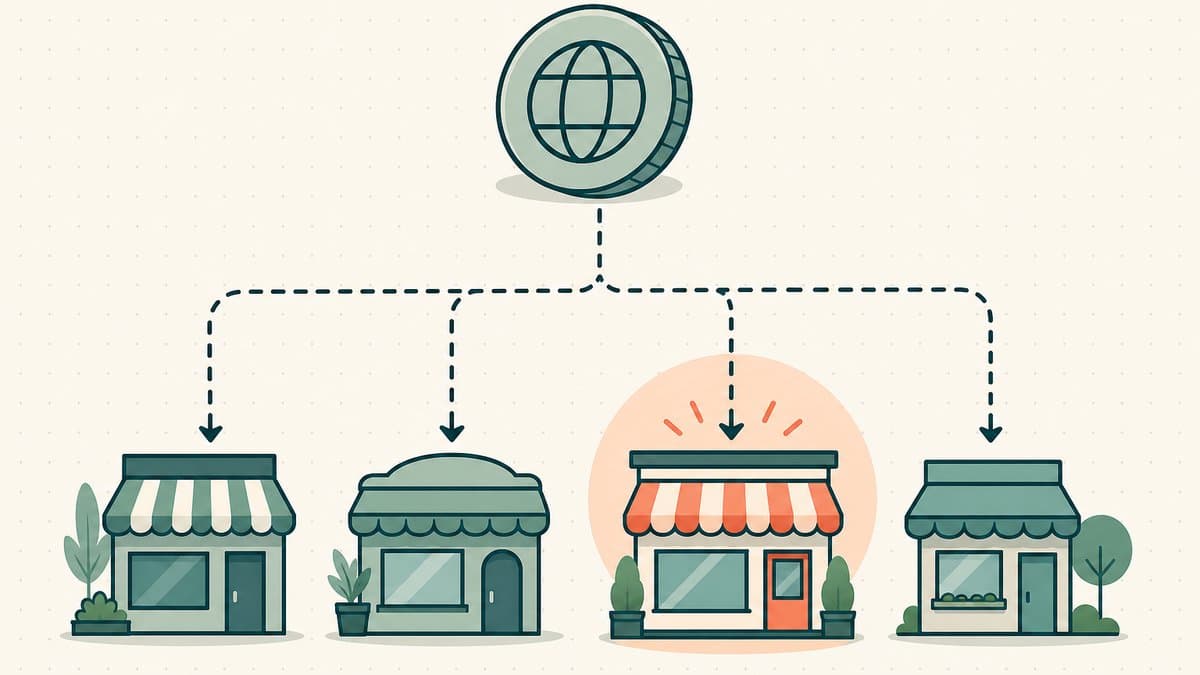
There's no single best marketplace, only a best fit for a given name. A rough decision guide:
| If the name is… | Lean toward |
|---|---|
| A liquid, crypto-recognizable string, buyer is NFT-native | OpenSea — widest reach, low 1% fee |
| Already sold (you have the buyer), you want zero fees + self-custody | A Seaport-based or zero-fee venue — atomic settlement |
| A real, resolving ICANN domain where DNS continuity and trust matter | A domain-native marketplace like Namefi |
| An ENS / Web3-native name, not a DNS domain | An ENS-aware venue — and price it as identity, not a website |
The deeper point is that onchain, you can list the same token in more than one place at once, because most of these venues read from the same wallet and the same ERC-721 contract. A pragmatic flipper often lists broadly on a general marketplace for reach and works the high-value names through a domain-native venue for context and trust. The custody model — keeping the name in your own multi-sig or single-key wallet until settlement — travels with you across all of them, which is the whole reason self-custodied marketplace sales beat the old escrow dance. For more on protecting the asset itself, see do multi-sig wallets actually improve security and the recovery playbook in recovering a tokenized domain after wallet loss.
Pick the venue for the name in front of you, not the other way around. The token's the same everywhere; the buyer is not.
Friendly Disclaimer (Read Me!)
We're not lawyers, accountants, financial advisors, or doctors, and nothing in this article is legal, financial, tax, accounting, medical, or any other flavor of professional advice. We write these posts to educate ourselves and as a convenience for our customers. Info here may be out of date, geography-specific, or just plain wrong. We make mistakes too.
For any important decision, please consult a real professional (seriously!). Or if that's not your vibe, ask a friend, ask Twitter, ask Reddit, ask an AI, or ask a psychic. In short: DOYR - Do Your Own Research. Let's learn and have fun.
Sources and further reading
- Ethereum Improvement Proposals — ERC-721 Non-Fungible Token Standard ("a standard interface for non-fungible tokens, also known as deeds")
- ProjectOpenSea/seaport (GitHub) — Seaport is a marketplace protocol for safely and efficiently buying and selling NFTs
- OpenSea Help Center — What fees do I pay on OpenSea? (1% selling fee; creator earnings enforced or optional)
- Blur — NFT Marketplace for Pro Traders (0% marketplace fees)
- ENS Documentation — What is ENS? ("a distributed, open, and extensible naming system based on the Ethereum blockchain")
- ENS Documentation — .eth Registrar pricing (length-based annual fees: ~$5/yr for 5+ characters, ~$640/yr for 3 characters)
Contributors

Fenwei Bian is a software developer in her thirties who spends her working hours in pull requests and her weekends with her hands in soil or sawdust. Years of open source on GitHub taught her that names are interfaces: a good one is clear, honest about what it does, and kind to whoever has to use it next.
She gardens because it rewards patience and punishes wishful thinking, and she does woodwork because a joint either fits or it doesn't. Both habits show up in how she writes about naming — measure twice, check the source, and don't sand over a rough spot and hope no one notices.
For Namefi she writes about how domain markets actually move, the practical trade-offs of tokenizing and flipping names, and picking a domain you'll still be glad you own in twenty years.

Victor Zhou is a technology founder and standards editor focused on digital identity and trust. He founded Namefi, edits Ethereum Improvement Proposals, and previously led smart-contract architecture work at Google Labs.
His work sits at the intersection of naming, ownership, and the systems people use to establish identity online. That perspective makes him especially interested in the way names move between personal meaning, public recognition, and digital infrastructure.
For Namefi, Victor edits and writes about domains as durable digital identity: how names become ownable onchain assets, how tokenization changes custody and trust, and what naming can learn from the systems people use to establish identity online.
Related guides
- ENS vs DNS Domain Flipping: What's DifferentHow flipping ENS .eth names differs from flipping traditional DNS domains: ownership, liquidity, renewal, gas, and what each is good for.
- ENS vs Unstoppable vs Tokenized DNS DomainsENS vs Unstoppable Domains vs tokenized ICANN DNS, compared on browser resolvability, renewals, and who actually controls the name.
- Appraising ENS and Tokenized Domains: Reading Onchain CompsHow to appraise ENS and tokenized domains using onchain comps, floor-versus-premium reasoning, and ENS club factors — and why it differs from DNS.
- How Tokenization Changes Domain FlippingHow bringing a domain on-chain can reshape flipping through verifiable token control, compatible marketplaces, and programmable settlement without removing registrar dependencies.