
How the TLD Affects a Domain's Value
How the extension after the dot moves a domain's price: the .com premium, the .io/.ai/.co context, and the policy and geopolitical risk behind ccTLDs.
- domains
- tld
- domain-flipping
- analysis

Take one good string of letters and price it across three extensions and you get three different numbers, sometimes off by an order of magnitude. The word didn't change. The part after the dot did. For a flipper, the extension is not a detail you tack on at the end of an appraisal. It is one of the largest single levers on what a name is worth and how easily it sells.
This piece breaks down how the top-level domain drives value: why .com still sits on top and commands a premium, where .io, .ai, and .co actually fit, and the policy and geopolitical risk baked into every country-code extension. It's part of our domain flipping series and a companion to the appraisal pillar, how to value a domain name. If "what's a TLD" is new to you, start with what a TLD is.
The .com premium is real, and it's a default tax
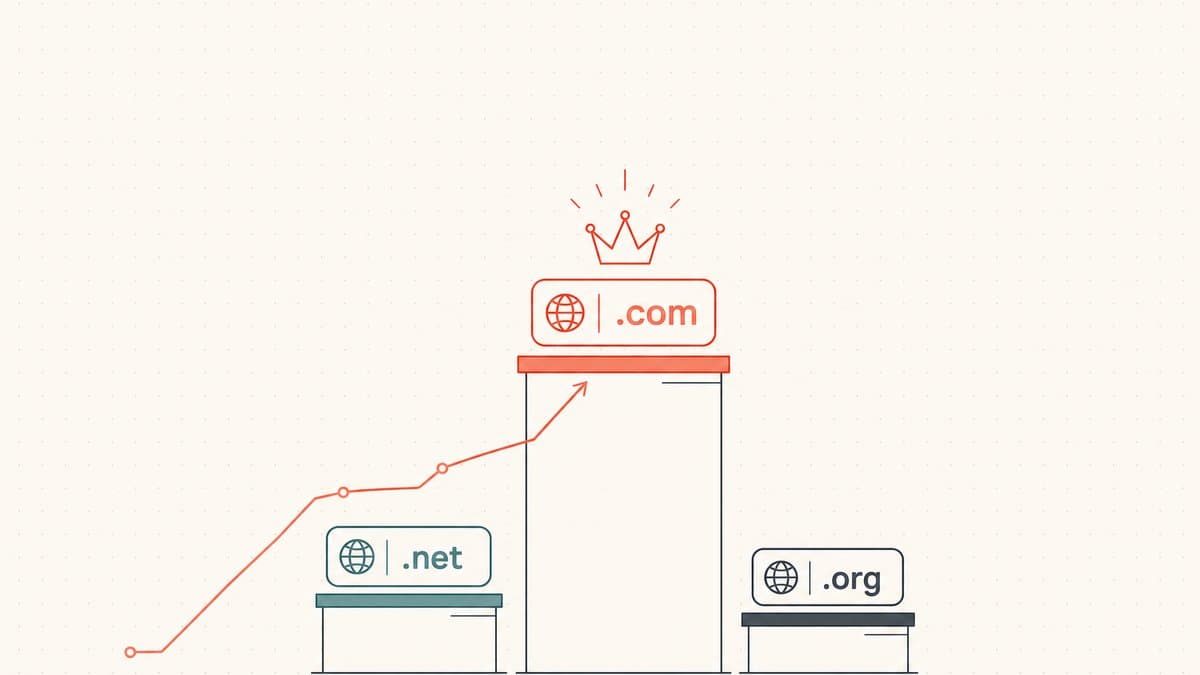
Start with the extension every other one is measured against. .com is, per Wikipedia, short for commercial, and it has grown into the largest top-level domain, with 161 Million registered names as of Q4 2025. No other extension is close.
That scale is exactly why a .com outprices the identical word on another TLD. .com is the extension people type without thinking, the one a customer assumes when they half-remember a brand, the one you never have to spell out on a phone call or read off a billboard. Every other extension carries a small ongoing cost: the owner has to correct the default. They put ".io, not .com" in the ad copy, they watch type-in traffic leak to the .com they don't own, and they answer "no, dot-c-o" more than they'd like. The premium buyers pay for the .com is the price of never paying that tax. For most generic, brandable, say-it-out-loud names, that's why the .com version is the high-water mark and everything else trades at a discount to it.
The premium is widest exactly where the name is most mass-market. A consumer brand that lives on word of mouth needs the .com; the cost of a confused customer is real money. A developer tool whose audience lives in a terminal cares far less. So the size of the .com premium is not a constant. It scales with how much the name's eventual buyer depends on people typing it from memory.
Where .io, .ai, and .co actually fit

The premium doesn't mean other extensions are cheap. It means they win on different terms. The strongest non-.com extensions don't try to beat .com at being the universal default. They win a segment so decisively that, inside that segment, they read as native.
.io is the developer badge. It's the ccTLD for the British Indian Ocean Territory, but the market reads it as I/O, input/output, and an entire generation of SaaS, dev-tools, and infrastructure companies adopted it as a signal of technical seriousness. The result is a hot, compressed namespace where good short names sell at five and six figures, the same dynamic that makes premium .coms expensive, packed into a smaller pool. We unpack the pricing in detail in why .io domains are expensive and on the .io TLD page.
.ai is the breakout. It's the Internet country code top-level domain (ccTLD) for Anguilla, and the AI boom turned a tiny territory's two letters into one of the most sought-after extensions on the market. The demand is concrete enough to show up in a national budget: per Wikipedia, in 2023, Anguilla's government made about US$32 million from fees collected for registering .ai domains; that amounted to over 10% of gross domestic product for the territory. For a flipper, .ai is where the demand curve is steepest right now, which means both the best upside and the most froth. We compare it head to head in .ai vs .io and on the .ai TLD page.
.co is the .com near-miss. It's the Internet country code top-level domain (ccTLD) assigned to Colombia, marketed globally as a shorter stand-in for .com ("co" for company), and any individual or entity in the world can register a .co domain. It reads cleanly and the available names are far better than .com. The catch is the same thing that makes it appealing: it's one letter from .com, so type-in traffic and trust both leak toward the .com a buyer probably doesn't own. See the .co TLD page for where it lands.
The pattern across all three: a non-.com extension is worth most when it owns a use case the .com can't claim. A .io to developers, an .ai to AI startups, an .app to mobile products. When the extension is just a cheaper substitute for an unavailable .com, the discount is steep and the resale market is thin. The literacy that separates these cases is the same set of fundamentals in what makes a domain valuable, and one whole sub-craft lives here: the domain hack, where the extension becomes the last syllable of the word, like instagr.am (.am is the internet country code top-level domain (ccTLD) for Armenia). We told that story in the instagr.am case study.
A ccTLD is somebody else's country
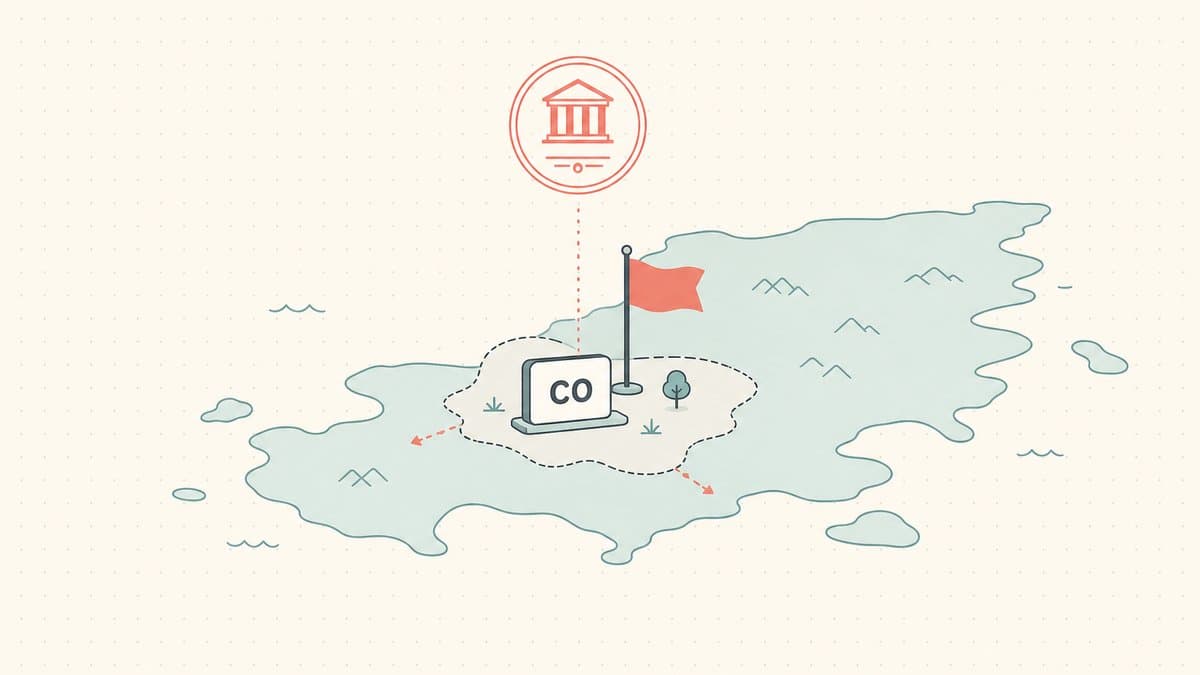
Here's the part most "best extensions for startups" lists skip, and it's the one that separates a hobbyist from someone who can actually price one of these. The extensions above (.io, .ai, .co, .am) are all country-code TLDs. When you register one, you are renting two letters of sovereign territory, and that territory makes the rules. A .com is governed by a stable, globally neutral framework. A ccTLD answers to a country, and countries change policy, restrict registration, and occasionally seize names.
The starkest version of this risk is the one a .com simply cannot carry: the country code itself can come into question. That's the open issue hanging over .io. Its existence depends on the British Indian Ocean Territory existing as a distinct entity, and that's exactly what's changing. The UK and Mauritius have agreed to transfer sovereignty of the Chagos Archipelago, and Wikipedia spells out the domain-level consequence plainly: after the transfer, current IANA rules may require the .io domain to be phased out, which would take at least 5 years. Nothing has shut down, the timelines are long and uncertain, and the realistic read is uncertainty rather than emergency. But it's a category of risk that doesn't exist for a .com, and thoughtful buyers now price that small tail risk in.
There's a quieter, more common flavor of ccTLD risk too: the registry can change the economics under you. A country can raise wholesale prices on renewal (which is much of why .io keeps getting more expensive to hold), tighten eligibility, or restrict what content is allowed. For a flipper holding a portfolio, that's a live line item, not a footnote. The lesson isn't "never touch a ccTLD." It's price the country in: learn the registry's policy, its track record on price increases, and how stable the territory is before you decide what a ccTLD name is worth.
Registration volume is not value
Newer flippers often reach for a tempting shortcut: pick the extension with the most registrations, on the theory that volume signals demand. It doesn't. The clearest cautionary tale is .tk, the country code top-level domain (ccTLD) for Tokelau, a territory of a few thousand people. Because users and small businesses were able to register any number of domain names free of charge under the Freenom free-registration model, at one point the .tk domain ranked first worldwide with 31,311,498 registered domain names — ahead of .cn. Yet .tk names carried roughly zero resale value, and the zone was a magnet for abuse: per Wikipedia, .tk domains were twice as likely as the global average to be used for "unwanted behaviours", including scams such as phishing and spam. When the free program collapsed, the apparent market share evaporated with it.
The takeaway: registration volume is a marketing signal, not a value signal. The numbers worth asking about are renewal rate and use rate, the share of names that survive a year and the share that actually resolve to something real. We dig into how this distorts the league tables in ccTLD market share by registration volume. A small, restricted, well-kept namespace beats a giant free-tier one for an investor every time.
How to weigh the extension when you appraise
Pull it together into a working checklist. When the extension is the variable in an appraisal, ask:
- Is there an exact-match
.com, and who owns it? The.comsets the ceiling. If a buyer can get the.com, your other-extension version competes against it and trades at a discount. If the.comis taken by an unrelated party and unavailable, a strong alternative extension is worth more, because there is no default to lose traffic to. - Does the extension own the buyer's use case? A
.iosold to a dev-tools founder or an.aisold to an AI startup is selling into native demand. The same name on a mismatched extension is a discount substitute. Match the extension to where it reads as the obvious choice, not the fallback. - How mass-market is the name? The more the eventual buyer relies on people typing the name from memory, the more the
.compremium matters and the more a non-.comis penalized. A name meant for word-of-mouth wants.com; a name meant for an audience that copy-pastes URLs can carry more extension risk. - Price the country in. For any ccTLD, factor the registry's policy, renewal-price trajectory, and political stability. A beautiful name on a volatile or expensive-to-renew ccTLD carries a discount a
.comnever would. - Ignore the volume table. Don't pay up for an extension because it's "huge." Ask about renewal and use rates instead. Big and cheap-to-register is often big because it's worthless.
The short version: the word sets the floor of what a name could be worth; the extension decides how much of that the market will actually pay, and how easily you'll find someone to pay it. Get the extension wrong and even a great word sits unsold.
What this looks like at the top of the market
One public anchor keeps the premium concrete. In February 2026, domain broker GetYourDomain.com announced the $70 million sale of AI.com, describing it as the largest domain transaction to date and more than double the prior $30 million Voice.com record. AI.com's own launch announcement says the domain was acquired in 2025 in a transaction believed to be the largest domain purchase in history. That's not a comp for a normal name. But it illustrates the principle at the very top of the market: the category-defining string and the default .com extension combine into an asset for which substitutes are difficult to price.
The Namefi angle
Once you've decided which extension a name should live on, the other half of the trade is moving it cleanly, and that's where the extension matters again in a practical way. Transferring a high-value name means proving who controls it and handing it over without the site going dark, and the mechanics differ across registries and country codes. That friction is the same one behind any high-value domain trade, and it's sharper across registrar and ccTLD boundaries.
This is the gap Namefi is built to narrow. Tokenized ownership makes control of a real ICANN domain easier to verify and transfer, with DNS continuity so the name keeps resolving through the handover. Choosing the right extension is the appraisal call; making the transfer of that name auditable is what lets you actually trade on the call.
Friendly Disclaimer (Read Me!)
We're not lawyers, accountants, financial advisors, or doctors, and nothing in this article is legal, financial, tax, accounting, medical, or any other flavor of professional advice. We write these posts to educate ourselves and as a convenience for our customers. Info here may be out of date, geography-specific, or just plain wrong. We make mistakes too.
For any important decision, please consult a real professional (seriously!). Or if that's not your vibe, ask a friend, ask Twitter, ask Reddit, ask an AI, or ask a psychic. In short: DOYR - Do Your Own Research. Let's learn and have fun.
Sources and further reading
- Wikipedia — .com (largest TLD; short for commercial; 161 million registered, Q4 2025)
- Wikipedia — .io (British Indian Ocean Territory; IANA phase-out would take at least 5 years)
- Wikipedia — .ai (Anguilla; ~US$32M in 2023, over 10% of GDP)
- Wikipedia — .co (Colombia; open to any registrant worldwide)
- Wikipedia — .am (Armenia)
- Wikipedia — .tk (Tokelau; free registrations, 31.3M peak, phishing/abuse)
- GetYourDomain.com via PR Newswire — AI.com sold for $70M, surpassing the prior $30M Voice.com record
- AI.com — 2026 launch announcement (domain acquired in 2025)
Contributors

Aileen Wright is a student in her twenties living in New York City, where the distance between a museum wall and a library reading room is a short walk and a long afternoon. She came to name writing through art and history — the way a single portrait, coin, or manuscript margin can carry a name across centuries and change its meaning on the way.
Most weeks you can find her in Central Park with a paperback, or in the quiet of a public reading room chasing down where a name actually comes from rather than what a name-list says it means. She is also teaching herself to code, which has made her oddly precise about spelling, sorting, and the small details that decide whether a name ages well.
For Namefi she writes about the history and culture behind domain names, the stories brands carry as they rename, and the difference between a good story and a verified source.

Victor Zhou is a technology founder and standards editor focused on digital identity and trust. He founded Namefi, edits Ethereum Improvement Proposals, and previously led smart-contract architecture work at Google Labs.
His work sits at the intersection of naming, ownership, and the systems people use to establish identity online. That perspective makes him especially interested in the way names move between personal meaning, public recognition, and digital infrastructure.
For Namefi, Victor edits and writes about domains as durable digital identity: how names become ownable onchain assets, how tokenization changes custody and trust, and what naming can learn from the systems people use to establish identity online.
Related guides
- Short, LLLL, and Numeric Domains: The Chinese-Market PremiumWhy Chinese buyers price short, four-letter, and numeric .com domains as a distinct asset class — pinyin, no-vowel premiums, and lucky 8 vs unlucky 4.
- How We Cut AI Buyer Discovery Cost by 85%: Start Lean, Escalate With EvidenceA practical method for cheaper buyer discovery using progressive model escalation, LLM-as-judge gates, and Laminar traces and evals.
- Appraising ENS and Tokenized Domains: Reading Onchain CompsHow to appraise ENS and tokenized domains using onchain comps, floor-versus-premium reasoning, and ENS club factors — and why it differs from DNS.
- Renewal Costs and Sell-Through Rate: The Real Math of DomainingThe honest economics of domaining: renewal drag, sell-through rate as a rule of thumb, and why one good sale has to fund many years of renewals.