
What Makes a Domain Name Valuable
Why one string of letters is worth thousands and a near-identical one is worth nothing: length, real words, the .com premium, intent, and brandability.
- domains
- domain-investing
- domain-flipping
- explainer

Two domains can be one letter apart and a thousand times apart in price. cars.com is a household asset; carz.net is a renewal bill. Same length, same rough idea, wildly different worth. Once you can explain why, most of domain investing stops feeling like luck and starts feeling like reading a market.
This is the literacy the rest of the name cluster hangs off. Appraisal puts a number on a domain; this explainer is about the layer underneath the number — the handful of properties that make a string of letters worth owning in the first place. Get fluent in these and you can glance at a name and know, within a wide band, whether it's an asset or a liability. It's the foundation for everything in our wider guide to domain flipping.
A domain is a memory, and memory is the product
Start with what a domain actually does. A domain name exists because numbers are hard to remember. As Wikipedia puts it, domain names serve to identify Internet resources ... with a text-based label that is easier to memorize than the numerical addresses used underneath, and an important function of domain names is to provide easily recognizable and memorizable names to those resources.
Hold onto that, because it explains nearly every value factor below. A domain's whole job is to be remembered, typed, and said. Every property that makes a name more memorable, more typeable, and more sayable makes it more valuable, and every property that makes it harder makes it worth less. Length, real words, clean spelling, a trusted extension — they're not arbitrary collector's preferences. They're all measuring the same thing: how easily a human can carry this name in their head and get back to it. If you only remember one idea from this piece, remember that the value is the memorability. To go from these fundamentals to an actual dollar figure, see how to value a domain name.
Length: shorter is almost always better
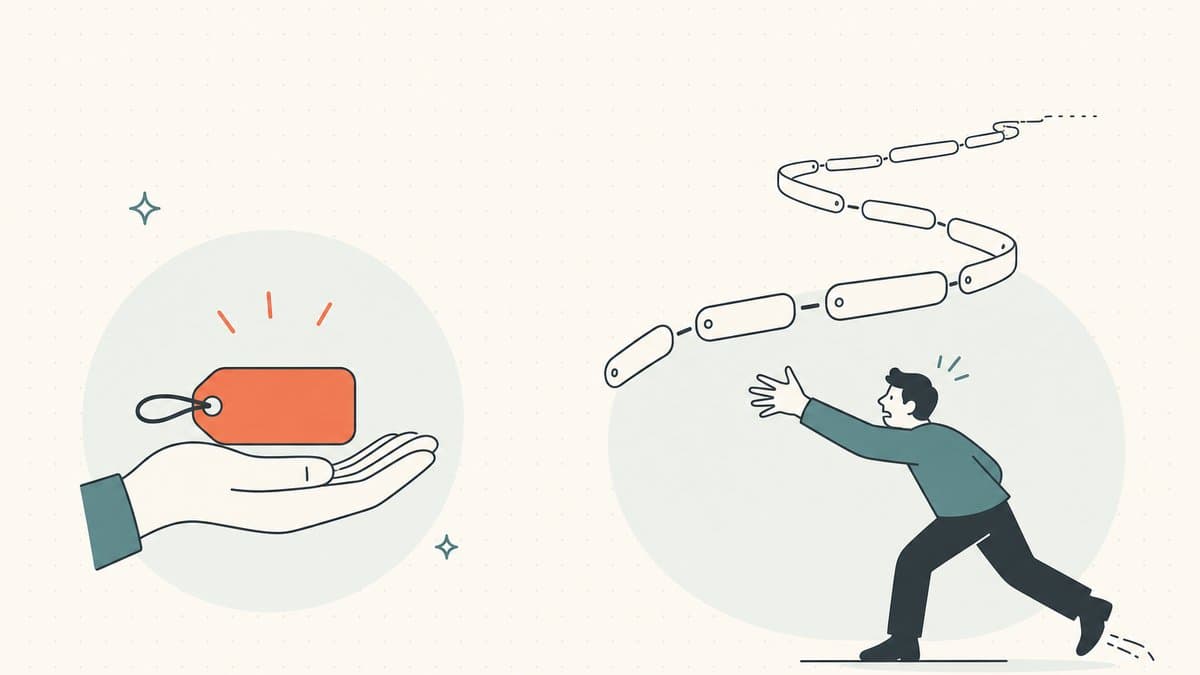
The first thing professionals look at is character count, because length is the cheapest proxy for memorability there is. Fewer letters are easier to recall, faster to type, simpler to fit on a sign or a business card, and harder for a competitor to crowd out with a near-match.
One-word and short two-word names sit at the top of the market. At the very top, single dictionary words and ultra-short letter or number strings are their own asset class — which is why the short-name market, including four-letter and numeric domains, trades with its own conventions and its own deep-pocketed buyers. Long, hyphenated, or number-padded strings sit at the bottom, because every extra character is one more thing the user has to get right to reach you. Length isn't the only factor, but it's the first filter, and a name that fails it rarely recovers on the others.
A real, searched, spoken word
Length tells you how much there is; the word tells you whether any of it means anything. This is the single biggest lever on value, and it has three tests a good name passes and a bad one fails.
Is it a real word or established term? cloud, loans, studio are words people already know. A made-up smash of letters carries no built-in meaning, so you'd have to buy that meaning later with marketing. (Invented names can still be valuable — more on that under brandability — but a random consonant pile is not the same as a craftable brand.)
Is it searched? A word is only commercially interesting if people actually look for the thing behind it. A name that maps to real demand has a built-in audience; a clever word nobody searches for is a curiosity. This is where naming overlaps with SEO: a name aligned with what people type into a search box arrives with attention already pointed at it.
Is it spoken cleanly? The radio test. Can you say the name out loud and have a stranger land on it without spelling anything? Names that need punctuation instructions — "that's I-N-S-T-A-G-R dot A-M" — lose value precisely because the recommendation breaks down the moment it leaves the screen. The move from instagr.am to instagram.com is the canonical fix for exactly this failure, and the broader lesson runs through every domain hack: clever to look at, costly when you have to say it aloud.
A name that passes all three tests is a fundamentally different asset from one that passes none.
The .com premium

Then there's the part after the dot, and one extension still sets the baseline for all the others. .com is the default the rest of the web is measured against. Wikipedia notes it is short for commercial and has grown into the largest top-level domain, with 161 Million names registered as of late 2025.
That ubiquity is the whole point. Because .com is what people assume, it's what they type without thinking, what they guess when they half-remember a brand, and what they trust by reflex. An identical name on .com therefore typically commands a real premium over the same name on another TLD — you're paying for the extension everyone defaults to. That doesn't make other extensions worthless; it means you should know the spread you're trading. A startup might rationally pick .io, .co, .app, or .xyz for fit, price, or availability, and the choice between a brandable name and a keyword .com is a real strategic fork. But the .com of a good word remains the benchmark, and for most mass-market buyers it's still the one they'll pay the most to own.
Keyword and commercial intent

Not every word is worth the same, even at the same length on the same extension. A word sitting next to a transaction is worth more than a word sitting next to a hobby, because the owner can convert attention on that word into revenue.
Insurance names illustrate both the appeal of commercial intent and the danger of reading headline prices as domain comparables. QuinStreet's reported $35.6 million Insurance.com transaction included the site's content, while its $49.7 million CarInsurance.com acquisition was a purchase of the company and related entities. Those totals cannot be assigned to the domain names alone. They do show that businesses commit substantial capital to digital properties positioned near a valuable customer decision, but an appraiser must separate the domain from traffic, content, revenue, contracts, trademarks, and the operating company. For a domain-only estimate, ask what a visitor or lead is worth to a plausible end user, then test that thesis against disclosed domain-only comparable sales rather than an entire-business acquisition.
Brandability: when an invented word wins
Keyword value is one road to a valuable name. Brandability is another. A brand can repurpose an ordinary dictionary word, as Stripe does, or use a coined name such as Zillow. What matters for a domain appraisal is whether the name is distinctive, pronounceable, memorable, and legally usable in the relevant market — not whether every successful example is invented.
The appeal is distinctiveness rather than generic meaning. A coined but sayable name may avoid some keyword crowding, while a familiar word may be easier to remember. Neither automatically creates enforceable trademark rights: registrability and scope depend on the mark, goods or services, jurisdiction, prior rights, and use. The appraisal test remains practical — can a buyer say, spell, remember, and lawfully use the name? We weigh the two approaches in brandable vs keyword domains and cover naming practice in how to name your project.
Extension stability: price the country in
There's a quieter factor that flippers usually learn the hard way: the durability of the extension is part of the value. A .com operates under a long-established ICANN and Verisign framework and is familiar worldwide, but it is not jurisdiction-neutral. A country code top-level domain is generally used or reserved for a country, sovereign state, or dependent territory, as Wikipedia summarizes — which means territorial policy and geopolitical change may add another category of risk.
The live example is .io, the technical world's favorite ccTLD. Its standing depends on the British Indian Ocean Territory existing as a distinct entity, and Wikipedia notes that after the planned Chagos sovereignty transfer, current IANA rules may require the .io domain to be phased out, which would take at least 5 years. Nothing has shut down, the timelines are long, and we lay out the measured version in why .io domains are expensive — but it's a category of risk a .com simply doesn't carry. The flip side is that an extension can also rise on outside demand: .ai, Anguilla's ccTLD, became so sought after that, per Wikipedia, in 2023, Anguilla's government made about US$32 million from fees collected for registering .ai domains. Stability cuts both ways. The discipline is the same: when you value a name on a ccTLD, you're valuing the territory's rules and trajectory along with the letters. Our breakdown of which extensions actually have liquid markets is in ccTLD market share by registration volume.
Putting the factors together
No single factor decides a name. Value is where several of them stack. The most expensive names in the world tend to score well on all of them at once — short, a real and searched word, on .com, with obvious commercial intent. Insurance.com is short, a real word, searched constantly, on the default extension, and sitting on top of a high-margin transaction. That's not one lever; it's five pulling together.
Most names you'll actually evaluate are mixed. A great word on a weak extension, a perfect extension wrapped around a forgettable word, a short string that doesn't spell anything. The skill is weighing the stack honestly rather than falling for the one factor that's strong and ignoring the three that are weak. And it's worth knowing that the disclosed market is only the visible part: Wikipedia's most-expensive list catalogs only sales with values of $3 million USD or more, and even the broad public record shows real depth — per the domain aftermarket overview, according to NameBio, 144,700 domain name sales totaling US$185 million were recorded in 2024. Most of that volume is ordinary names changing hands on exactly the fundamentals above.
Once you can read the fundamentals, the rest of the cluster opens up: the domain hacks explainer is these same drivers applied to clever cross-the-dot names, and how to value a domain name turns the read into a number you can list.
The Namefi angle
Knowing what a name is worth is one skill. Trading on that knowledge safely is another. The moment a valuable name changes hands, the value factors stop mattering and the mechanics take over: the buyer doesn't want to pay before they control the asset, and the seller doesn't want to release control before they're paid. That trust gap is where high-value domain trading gets nervous.
This is the gap Namefi is built to narrow for supported domains. Tokenization makes the token-control history publicly auditable, and a standard domain NFT can be offered through compatible third-party venues whose own contracts and rules determine settlement. Namefi's Terms state that the platform is not itself an escrow agent, exchange, or broker. The token also does not by itself establish legal or registrar title: registry records, ICANN policy, platform agreements, disputes, and court orders still apply. Read the name first; then understand which control, venue, and legal layers the trade actually moves.
Friendly Disclaimer (Read Me!)
We're not lawyers, accountants, financial advisors, or doctors, and nothing in this article is legal, financial, tax, accounting, medical, or any other flavor of professional advice. We write these posts to educate ourselves and as a convenience for our customers. Info here may be out of date, geography-specific, or just plain wrong. We make mistakes too.
For any important decision, please consult a real professional (seriously!). Or if that's not your vibe, ask a friend, ask Twitter, ask Reddit, ask an AI, or ask a psychic. In short: DOYR - Do Your Own Research. Let's learn and have fun.
Sources and further reading
- Wikipedia — Domain name (memorability and identification function)
- Wikipedia — .com (short for commercial; largest TLD; 161M registered, Q4 2025)
- Domain Investing — QuinStreet Paid $35.6 Million for Insurance.com (transaction included content; not a domain-only comparable)
- GlobeNewswire — QuinStreet Announces Acquisition of CarInsurance.com, Inc. ($49.7M cash) (company, shares, and related-entity acquisition; not a domain-only comparable)
- Wikipedia — List of most expensive domain names (Hotels.com $11M/2001; $3M+ public scope)
- Wikipedia — Country code top-level domain (definition)
- Wikipedia — .io (IANA phase-out risk after Chagos transfer)
- Wikipedia — .ai (Anguilla's 2023 .ai registration revenue)
- Wikipedia — Domain aftermarket (NameBio 2024 sales volume)
- Cambridge Dictionary —
stripe(dictionary-word classification) - Namefi — Terms of Service and Registration Agreement (token-control, registrar, policy, dispute, and legal layers)
Contributors

Fenwei Bian is a software developer in her thirties who spends her working hours in pull requests and her weekends with her hands in soil or sawdust. Years of open source on GitHub taught her that names are interfaces: a good one is clear, honest about what it does, and kind to whoever has to use it next.
She gardens because it rewards patience and punishes wishful thinking, and she does woodwork because a joint either fits or it doesn't. Both habits show up in how she writes about naming — measure twice, check the source, and don't sand over a rough spot and hope no one notices.
For Namefi she writes about how domain markets actually move, the practical trade-offs of tokenizing and flipping names, and picking a domain you'll still be glad you own in twenty years.

Victor Zhou is a technology founder and standards editor focused on digital identity and trust. He founded Namefi, edits Ethereum Improvement Proposals, and previously led smart-contract architecture work at Google Labs.
His work sits at the intersection of naming, ownership, and the systems people use to establish identity online. That perspective makes him especially interested in the way names move between personal meaning, public recognition, and digital infrastructure.
For Namefi, Victor edits and writes about domains as durable digital identity: how names become ownable onchain assets, how tokenization changes custody and trust, and what naming can learn from the systems people use to establish identity online.
Related guides
- Domain Backorders and Drop-Catching, ExplainedWhat domain backorders and drop-catching are, how services race to grab a name the instant it releases, and when a backorder is worth paying for.
- What Is Domain Parking? Parked Domains and MonetizationLearn what a parked domain is, why people park domains, and how parking, sale landing pages, and monetization differ.
- End-User Price vs Reseller Price: Why One Domain Has Two NumbersWhy a domain has a low wholesale/reseller price and a much higher end-user price, how big the spread is, and which number applies to your sale.
- Expired Domains and the Drop Cycle, ExplainedHow a domain expires and drops: grace period, the 30-day redemption window, 5-day pending delete, release — and where dropped names surface for flippers.