
When to Drop a Domain (and Cut Your Losers)
How to decide when to let a domain expire: renewal cost vs realistic resale odds, the sunk-cost trap, and the signals a name will never sell.
- domains
- domain-investing
- domain-flipping
- guide

Every domain you own sends you the same letter once a year: renew or lose it. For your winners that's an easy yes. The hard decisions are the names in the middle and the bottom of your portfolio — the ones you registered with a thesis that hasn't paid off, the impulse buys, the "almost" names that have sat unsold through three renewal cycles. Deciding which to let go is one of the least glamorous and most profitable skills in flipping, because money saved on dead inventory goes straight to your bottom line.
This guide is about the drop decision: weighing a renewal fee against realistic resale odds, spotting the sunk-cost trap that keeps bad names on life support, and the signals that a name will never sell. It's the counterpart to acquiring well — a discipline covered across the domain flipping series and, at the portfolio level, in domain portfolio management.
The renewal bill is the whole game
Start with the number you're actually deciding about. A domain isn't bought once; it's rented in terms, and a gTLD registration tops out at, per Wikipedia, the maximum period of registration for a gTLD domain name is 10 years. Whatever term you chose, the renewal comes due, and for a plain .com it's modest — Wikipedia notes that as of 2023, the retail cost generally ranges from a low of about $9.70 per year to about $35 per year for a simple registration.
Ten or twenty dollars feels trivial, and that's exactly the trap. The fee per name is small; the fee across a portfolio is not. A flipper holding three hundred names writes a low-four-figure check every year just to keep the lights on, most of it on names that will never sell. On premium extensions it's harsher — a .io or .ai name can cost many times a .com to renew, so a single dead .ai carries the renewal weight of a dozen .coms. The renewal bill is the carrying cost of your inventory, and the drop decision is portfolio-level cost control. We break the math down in domain renewal costs and sell-through rate.
The mental model worth internalizing: each renewal isn't a sunk cost you're protecting, it's a fresh purchase you're choosing to make. Every year you renew, you buy the name again at the renewal price. So ask the question you'd ask of any new purchase: would I pay this today, at this price, to acquire this exact name? If the answer is no, you have your answer about the renewal too.
Renewal cost vs realistic resale odds
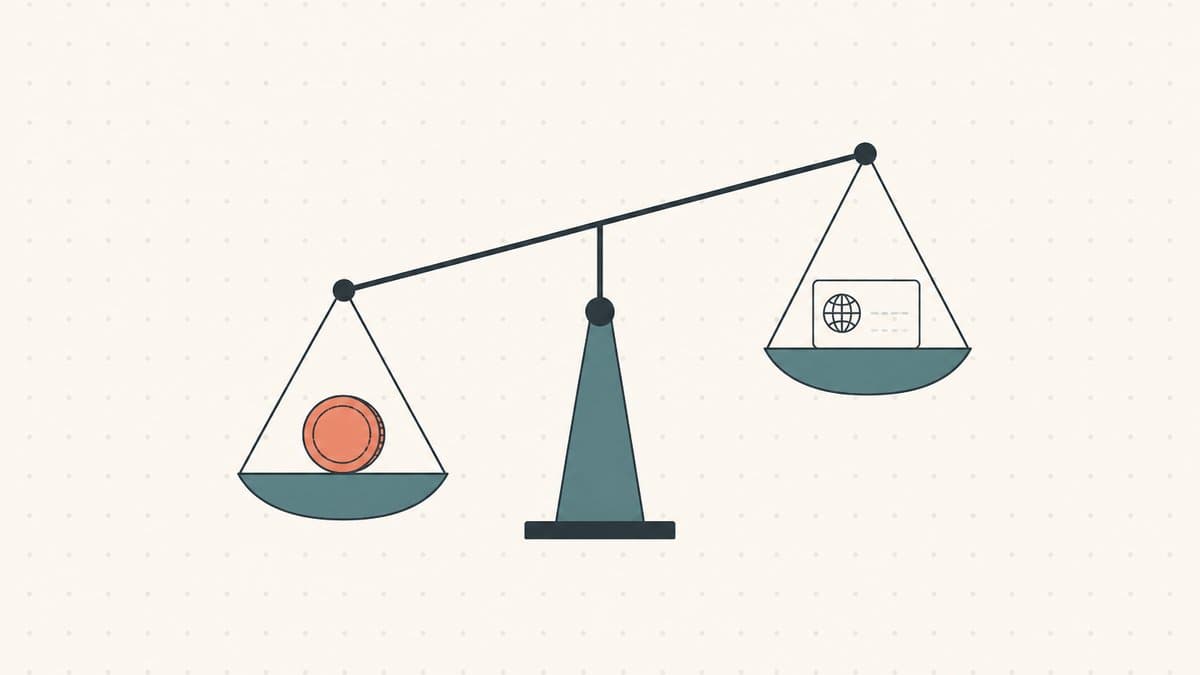
The renew-or-drop call is an expected-value problem. A name is worth keeping when its expected resale value, discounted by how likely it is to sell and how long you'll wait, comfortably exceeds the cost of renewing it until then.
The trouble is the second half of that equation. Most domainers overestimate their resale odds because they anchor on headline outcomes — the Voice.com and Sex.com scale sales that survive into the press — rather than the base rate. The industry rule of thumb, and it is a rule of thumb rather than a measured statistic, is that a hand-registered portfolio's annual sell-through rate (the share of names that sell in a given year) sits in the low single-digit percentages. Treat that as an estimate, but treat it seriously: if your odds of selling a mediocre name this year are a couple of percent and your expected price is a few hundred dollars, the expected annual return is a few dollars. Once the renewal fee approaches that number, the name is no longer an investment. It's a subscription you keep paying out of hope.
This is why valuation discipline doesn't stop at acquisition. The same inputs that tell you what to pay — comparable sales, the liquidity of the extension, whether a real buyer use case exists — tell you whether to keep paying. A name bought on a sound thesis that two years of silence have disproven is not the same asset you acquired. The market has voted. Re-run the appraisal you'd run on a fresh buy (the method is in how to value a domain name), and if today's honest number is below your remaining carrying cost, drop it.
The sunk-cost trap
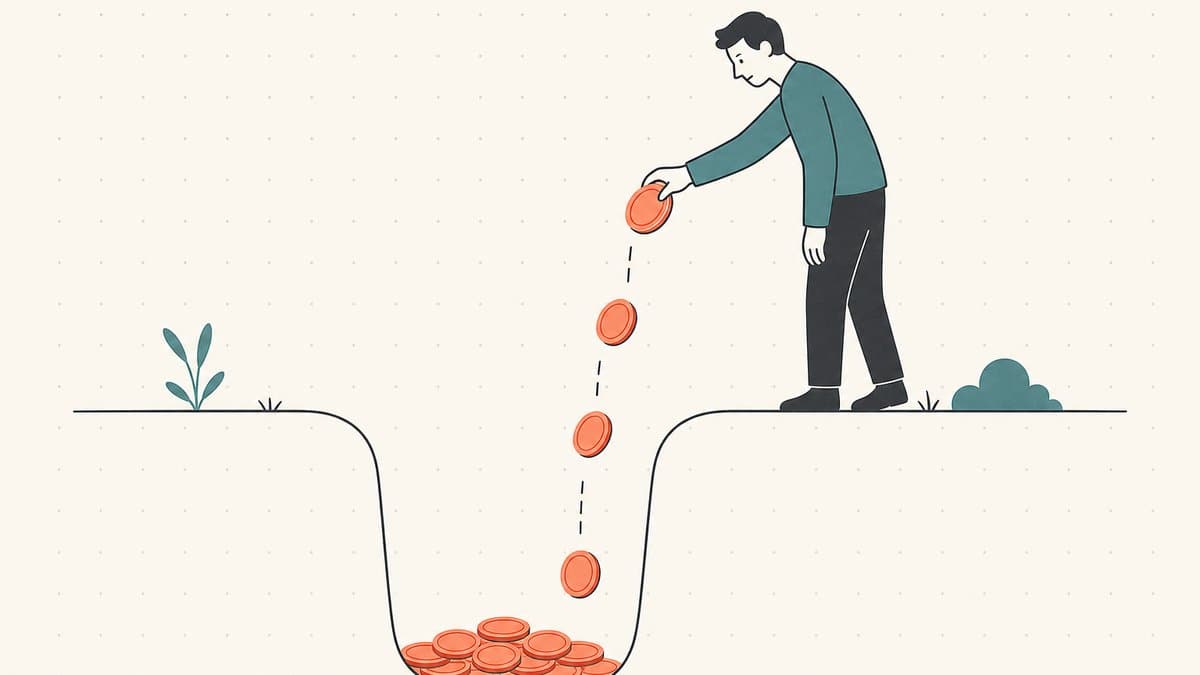
The single biggest reason flippers keep losers is psychological, and it has a name. A sunk cost is, in the standard definition, a cost that has already been incurred and cannot be recovered. The acquisition price you paid for a domain, plus every renewal you've already made, is gone the moment you spent it. Whether you renew again has zero effect on recovering it. The only thing that money is doing now is biasing your decision.
The fallacy is well documented: people show a greater tendency to continue an endeavor once an investment in money, effort, or time has been made. For domainers this shows up as a specific, predictable mistake. You paid $2,000 for a name three years ago. It hasn't sold. The renewal is $30. You renew, because dropping it would mean "wasting" the $2,000 — even though the $2,000 was wasted years ago and the renewal is a separate, brand-new $30 you're now choosing to throw after it. That's the literal definition of throwing good money after bad.
The cure is a rule, not willpower. When the renewal notice arrives, ignore what you paid and what you've already spent renewing. Those numbers are not inputs to today's decision. Ask only: at this renewal price, would I acquire this name today? If you wouldn't buy it fresh, you shouldn't buy it again — which is what renewing is. Track acquisition cost and cumulative holding cost in your portfolio sheet for tax purposes, but deliberately don't look at those columns when making the renew call. The accounting and the decision are different jobs (the tax side is its own topic in taxes and accounting for domain investors); conflating them is how losers survive.
Signals a name will never sell
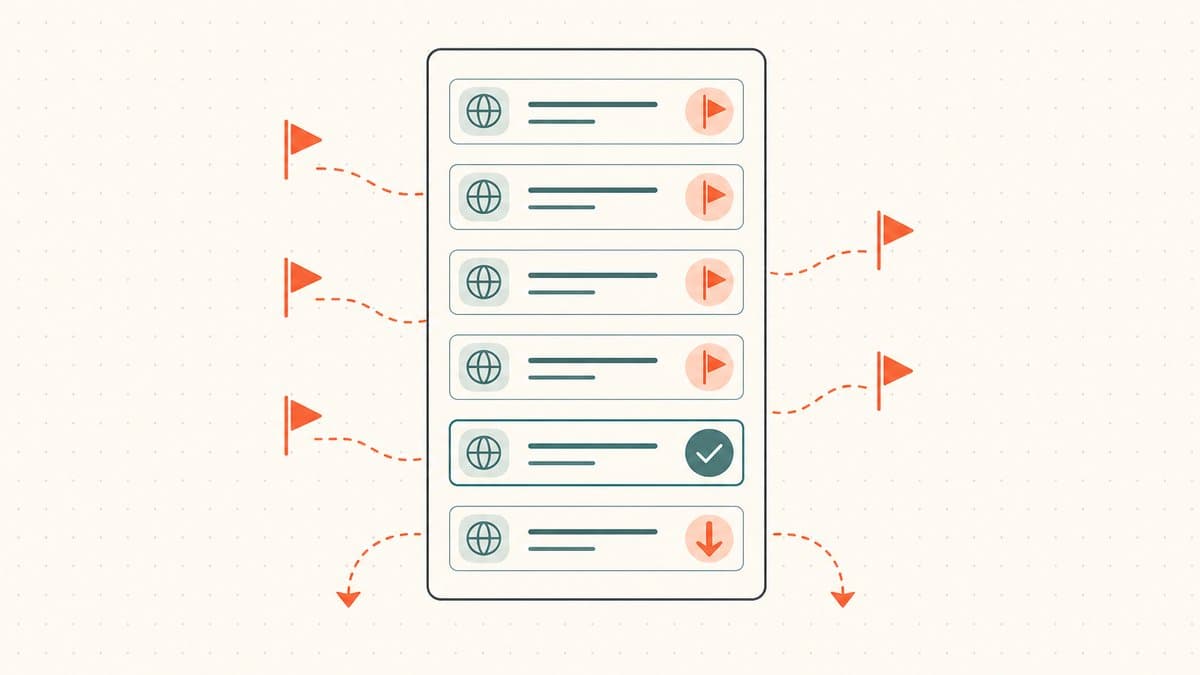
Expected value is the framework, but in practice you're scanning a list of names quickly, and a handful of concrete signals reliably flag a name that should go. None is fatal alone; two or three together is a clear drop.
- No inbound interest, ever. If a name has been listed and discoverable for two or more years and generated zero offers, zero inquiries, not even lowball spam, the market is telling you something. A name nobody has asked about isn't "undiscovered" — listing largely solves discovery. It's unwanted. This is the strongest single signal.
- No identifiable buyer. Good flips have an obvious buyer in mind: a category, an industry, a type of startup that needs exactly this string. If you can't name a single concrete company that would pay for the name, you bought a name with no buyer, and that doesn't sell at any price.
- You can't explain why you bought it. Portfolios accumulate impulse registrations that seemed clever at 1 a.m. If you can't reconstruct the thesis, there usually wasn't one. These are the easiest, guilt-free drops.
- It needs an explanation to be understood. Names that require spelling out, mix in numbers or hyphens, or read as a clever construction nobody can repeat after hearing it once fail the say-it-out-loud test. The fundamentals in what makes a domain valuable are the checklist; a name that flunks several won't improve with another renewal.
- The thesis expired with a trend. A name minted on a hype cycle that's now over — last year's buzzword, a fad that didn't stick — has a buyer pool that shrinks every quarter. If the trend passed and the name didn't move, it's a depreciating hold.
- A trademark problem you missed at registration. Occasionally you'll realize a name leans on someone else's mark. Under the UDRP that's a liability, not an asset, and the right move is usually to drop it rather than risk a dispute. The line between domaining and squatting is covered in what is UDRP.
A name hitting one signal might be a hold-and-watch. A name hitting several is renewal money you should redirect into a better acquisition.
How to actually drop a name (and when not to)
Dropping a domain is almost always a non-action: you don't renew, and the name runs through the expiration lifecycle on its own. It doesn't vanish the day it lapses — it moves through a grace period, then redemption, then pending delete before the registry releases it back to the pool. That full sequence, and where dropped names resurface for other flippers, is laid out in expired domains and the drop cycle. The cycle matters here for one practical reason: once you decide to drop, do nothing. Don't pay a redemption fee in a moment of second-guessing — recovering a name after it's deleted into redemption typically costs a fee that Wikipedia puts at a level where an owner may be required to pay a fee (typically around US$100) to re-activate and re-register the domain, and that window is usually around 30 to 90 days depending on the TLD. If you wouldn't pay the normal renewal, you certainly shouldn't pay a $100 redemption to reverse a drop you chose on purpose.
There are a few cases where you should not simply drop, and it's worth knowing them:
- It has even modest resale value — try to sell it first. A losing hold is still an asset until it expires. Before dropping a name with any plausible demand, list it cheaply or float it on a marketplace; recovering even your cost basis beats letting it drop for free. The mechanics are in how to sell a domain name you own, and if a buyer appears, a neutral escrow handoff (or a tokenized equivalent) keeps the deal clean.
- Someone is mid-conversation about it. Never let a name lapse while an inquiry is open. Renew a short term to keep it alive through the negotiation.
- It's part of a set or a defensive hold. If the name protects a brand you actively use or completes a matching pair (a hack plus its
.com, for instance), its value is in the set, not the standalone odds.
For everything else, the cleanest discipline is an annual prune. Once a year, before the renewal wave hits, walk the list, apply the signals above, and let the dead inventory expire. The renewal money you free up is the budget for next year's better buys.
The Namefi angle
Pruning is the unglamorous half of running a portfolio; the other half is moving the names that do find a buyer without friction. When one of your held names finally gets an offer, the deal still hinges on the same old standoff — who transfers first, who pays first — and that friction is sharpest on exactly the higher-value names worth holding through extra renewals. Namefi narrows that gap: tokenized ownership makes control of a real ICANN domain easier to verify and transfer, with DNS continuity so the name keeps resolving cleanly through the handover. Fewer settlement headaches means the names you chose to keep are the names you can actually liquidate when the time comes.
Friendly Disclaimer (Read Me!)
We're not lawyers, accountants, financial advisors, or doctors, and nothing in this article is legal, financial, tax, accounting, medical, or any other flavor of professional advice. We write these posts to educate ourselves and as a convenience for our customers. Info here may be out of date, geography-specific, or just plain wrong. We make mistakes too.
For any important decision, please consult a real professional (seriously!). Or if that's not your vibe, ask a friend, ask Twitter, ask Reddit, ask an AI, or ask a psychic. In short: DOYR - Do Your Own Research. Let's learn and have fun.
Sources and further reading
Contributors

Fenwei Bian is a software developer in her thirties who spends her working hours in pull requests and her weekends with her hands in soil or sawdust. Years of open source on GitHub taught her that names are interfaces: a good one is clear, honest about what it does, and kind to whoever has to use it next.
She gardens because it rewards patience and punishes wishful thinking, and she does woodwork because a joint either fits or it doesn't. Both habits show up in how she writes about naming — measure twice, check the source, and don't sand over a rough spot and hope no one notices.
For Namefi she writes about how domain markets actually move, the practical trade-offs of tokenizing and flipping names, and picking a domain you'll still be glad you own in twenty years.

Victor Zhou is a technology founder and standards editor focused on digital identity and trust. He founded Namefi, edits Ethereum Improvement Proposals, and previously led smart-contract architecture work at Google Labs.
His work sits at the intersection of naming, ownership, and the systems people use to establish identity online. That perspective makes him especially interested in the way names move between personal meaning, public recognition, and digital infrastructure.
For Namefi, Victor edits and writes about domains as durable digital identity: how names become ownable onchain assets, how tokenization changes custody and trust, and what naming can learn from the systems people use to establish identity online.
Related guides
- For-Sale Landing Pages That ConvertHow to build a domain for-sale landing page that converts: a clear price or offer path, real trust signals, and a frictionless way to buy or make an offer.
- Running a Domain Portfolio Like a BusinessRun your domains like inventory: track cost basis, watch sell-through rate, control renewal drag, prune losers, and keep the books clean.
- Domain Pricing Psychology: Buy-Now vs Make-OfferHow listing mode and initial numbers can influence a domain sale: anchoring, when to name a price, planned concessions, and buy-now vs make-offer.
- Hand-Registering Domains to Flip: Finding Available GemsHow to find still-available domains worth a registration fee: wordlists, TLD permutations, brandable patterns, and the filters that beat impulse buys.