
What Does a Domain Broker Do? Fees, Services, and How to Choose
Learn when a domain broker helps, how buyer and seller representation differ, and which fees, incentives, and terms to check before hiring one.
- domains
- domain-investing
- domain-flipping
- explainer

A domain broker helps a buyer acquire a registered domain or helps its owner find and negotiate with buyers. The engagement can include research, outreach, negotiation, and coordination of the transfer. Its value depends on the agreed work and fees, not a universal minimum domain price. This is the broker chapter of our domain flipping series, alongside the selling pillar, how to sell domains for profit.
When a broker is worth the cut
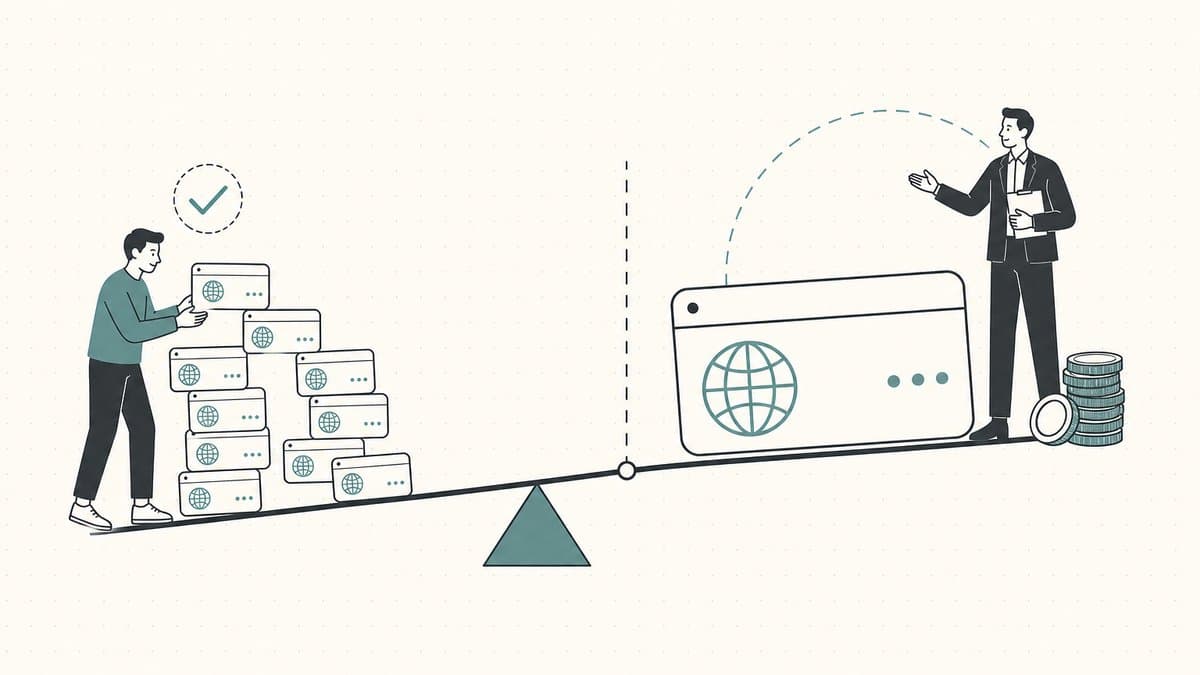
A broker is leverage, and leverage only pays when the expected benefit exceeds every fee. There is no evidence-backed universal price threshold: the decision depends on the name, buyer pool, legal risk, broker terms, expected sale price, and work you can perform yourself. Calculate your net proceeds under the actual commission, minimum, upfront fee, exclusivity, and tail clause before engaging anyone.
The deals that justify a broker share a shape:
- High expected value relative to fees. A broker can make sense when negotiation, buyer access, or transaction management is likely to improve your net result after every fee. That is a deal-specific calculation, not a fixed dollar threshold.
- A narrow but legitimate buyer pool. A broker can buffer negotiation when only a few independent business users fit a genuinely generic or brandable name. Do not acquire or target a name primarily because it corresponds to someone else's trademark: WIPO's UDRP overview identifies registration or acquisition primarily to sell to the trademark owner for excess value as evidence that can support bad-faith findings, depending on the full facts.
- A principal seeking confidentiality. A broker can keep a buyer or seller's identity private during early negotiation. Confidentiality may change the negotiation dynamic, but it does not prove that either side has a particular budget or reservation price.
- A delicate but lawful approach. Outbound outreach should present an independent legitimate interest in the name and avoid threats, trademark targeting, or pressure. A broker does not make an otherwise abusive registration or solicitation safe.
For straightforward names and transactions, self-service listing and escrow may produce a better net result. The selling pillar walks the full do-it-yourself path in how to sell a domain name you own.
What a good broker actually does

The word "broker" undersells the job. A good one is not a middleman who forwards emails. They are a negotiator, a researcher, and a deal closer, and the value lives in the parts of the transaction an owner is worst positioned to handle.
They create negotiating distance. This is the single biggest thing you're buying. When you negotiate your own name, every signal you send about how much you want the deal becomes a price discount. A broker sits between you and the buyer, so your eagerness never reaches the other side of the table. They can float a number, walk it back, go quiet for a week, and let silence do work that a personally invested owner can't stomach.
They know who the real buyer is. On the buy side especially, a broker's job is to identify the actual decision-maker inside a company and the actual current holder of a name, then open a line to both. Domains often sit in the domain aftermarket, defined by Wikipedia as the secondary resale market for Internet domain names in which a party interested in acquiring a domain that is already registered bids or negotiates a price, and finding the right counterparty in that market is a relationship game brokers play full-time.
They anchor and shape the price. A broker has seen comparable sales you haven't and can defend a number with data rather than hope. They set the opening anchor, manage the concession schedule, and keep the conversation from collapsing into a single take-it-or-leave-it figure. This is the pricing craft we cover in domain pricing psychology: buy now vs make offer, applied by someone who does it for a living.
They run the close. The riskiest part of any deal is the handover, where the seller does not want to give up control before getting paid and the buyer does not want to pay before receiving it. A broker can manage escrow and coordinate the appropriate ownership-change process. A same-registrar change of registrant is not the same as an inter-registrar transfer; only the latter ordinarily uses the gaining registrar and an auth code. ICANN's Transfer Policy and each registrar's process determine approvals, eligible opt-outs, and any 60-day lock.
Sell-side vs buy-side brokerage
| Question | Buyer representation | Seller representation |
|---|---|---|
| Who hires the broker? | Someone seeking a domain they do not own | The current domain holder |
| Main assignment | Contact the holder and negotiate an acquisition | Identify interested buyers and negotiate a sale |
| Terms to settle | Spending limit, identity disclosure, upfront and success fees | Asking strategy, exclusivity, commission, and any post-engagement fee obligation |
| Incentive to examine | A percentage of purchase price can rise as the buyer spends more | A commission rewards a completed sale; speed and highest price may conflict |
Sedo's published brokerage services illustrate the two roles. The incentive comparison is a reason to ask how your interests are represented, not an allegation about any provider. Ask who the broker represents, who pays them, and whether they receive any payment from the other side or a recommended service.
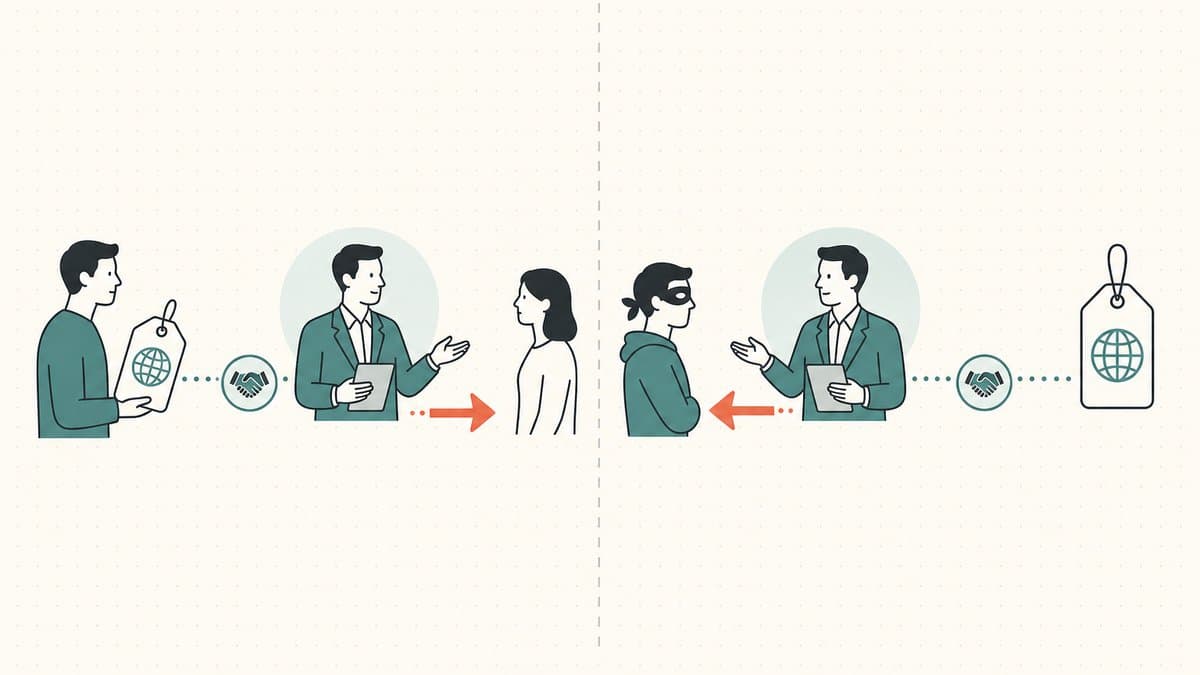
"Broker" covers two distinct jobs, and the one you need depends on which side of the table you're on. That is separate from the inbound vs outbound distinction: a sell-side broker can respond to inbound demand or conduct outbound outreach, while a buy-side broker can approach a seller on the buyer's behalf.
Sell-side brokerage means the broker represents the domain owner. A buyer may already have surfaced, or the engagement may include lawful outbound marketing. The broker negotiates and helps run the close under the fee and exclusivity terms in the agreement. Some platforms layer brokerage on top of listings — see where to sell domains: marketplaces compared for how venues differ.
Buy-side brokerage means the broker represents a buyer seeking a domain it does not own. The broker researches the holder, opens a line, and may keep the principal confidential during negotiation. Confidentiality can reduce signaling, but there is no universal multiplier for what disclosure does to price, and the engagement must still respect trademark and UDRP risk.
If you are the flipper, you are usually on the sell side. A broker who approaches you may represent a confidential principal, but anonymity does not prove that the client is wealthy or that the domain is worth more than the opening bid. Evaluate the name, comparables, legal posture, and offer on their own evidence.
What commissions look like
There is no universal brokerage rate. As a dated example, Sedo's price list, checked September 15, 2026, lists a USD 99 one-time buyer brokerage fee plus 20% of the gross sale price, subject to its minimum fee. Its seller brokerage lists 15% of the gross sale price on a successful sale and no upfront cost. Minimums, taxes, and optional publicity-waiver charges also apply. These are Sedo's brokerage terms, not a market average or its separate self-service marketplace rates.
A few things to pin down in writing before you sign anything:
- The exact percentage and any minimum. Get the number and the floor.
- Whether the engagement is exclusive, and if so for how long. An exclusive listing means you can't also sell the name yourself or list it elsewhere during the term.
- What counts as a commissionable sale. Specifically, whether the broker is owed a fee if a buyer they introduced closes after the engagement ends. This "tail" clause catches sellers off guard.
- Who pays escrow and transfer fees, and how the money flows at close.
There's no universally correct rate, and a higher commission from a broker who actually delivers a bigger price beats a lower one from someone who lists your name and waits. Run the math on the net you'd clear, not the percentage you'd pay.
How to vet a broker
The barrier to calling yourself a domain broker is roughly zero, which means vetting is on you. The good ones are worth far more than their fee; the bad ones are a worse outcome than selling it yourself, because they tie up your name under an exclusive and then do nothing. Before you sign:
- Ask for a verifiable track record. Real brokers have closed deals and can speak to comparable sales, even if confidentiality keeps them from naming every buyer. Vague claims of "many large transactions" with nothing concrete behind them are a flag.
- Check how they get paid, and when. Legitimate business models vary. Some sell-side brokers work only for a success commission; established acquisition services can charge a nonrefundable upfront fee plus commission. An upfront fee is therefore not proof of fraud, but it must be disclosed, justified, and paid to a verified provider under written terms. Be wary of unsolicited appraisal schemes, guaranteed-sale claims, pressure, or instructions to pay an unknown third party.
- Confirm they use real escrow and a clean transfer. The broker should insist on a neutral third party holding funds, and should understand the transfer mechanics and the lock windows cold. A broker who's casual about the handover is a broker who'll lose you a deal, or a name. For how those handovers get attacked, how domain hijacking actually happens is the cautionary read.
- Read the exclusivity and tail terms before you sign, not after. A long exclusive with a broad tail clause and no performance commitment is the worst deal in the business: you've handed away your name and your time for nothing.
- Talk to the wider community. The domain trader forums and the domainer blogs and newsletters are full of people who've worked with specific brokers and will tell you, often bluntly, who's real. The broader domain industry media is another reputation check. Reputation in this business travels.
The through-line: a broker should be transparent about fees, incentives, exclusivity, conflicts, and the close. Verify the provider and written terms before paying either upfront or success-based fees.
The Namefi angle
High-value handovers involve counterparty, escrow, registrar, DNS, and legal risk. A good broker manages that friction with relationships and process. Namefi adds an auditable token-control layer and can support atomic token-and-payment settlement on compatible venues, while registrar and registry records, ICANN policy, platform agreements, disputes, and court orders still apply. That can reduce risk in the onchain trade legs; it does not replace due diligence, escrow judgment, or legal advice. If you want the longer view, see how tokenized marketplaces replace escrow.
Friendly Disclaimer (Read Me!)
We're not lawyers, accountants, financial advisors, or doctors, and nothing in this article is legal, financial, tax, accounting, medical, or any other flavor of professional advice. We write these posts to educate ourselves and as a convenience for our customers. Info here may be out of date, geography-specific, or just plain wrong. We make mistakes too.
For any important decision, please consult a real professional (seriously!). Or if that's not your vibe, ask a friend, ask Twitter, ask Reddit, ask an AI, or ask a psychic. In short: DOYR - Do Your Own Research. Let's learn and have fun.
Sources and further reading
-
Sedo — Price list, “Brokerage Services,” buyer and seller fees and exclusions. Fetched 2026-09-15.
-
Wikipedia — Domain aftermarket (definition of the secondary resale market where brokers operate)
-
Wikipedia — Domain name transfer (transfer process and the authentication code handover a broker coordinates)
-
WIPO — WIPO Overview of WIPO Panel Views on Selected UDRP Questions, section 3.1 (circumstances that can support a bad-faith finding, including acquisition primarily to sell to a trademark owner)
-
ICANN — Transfer Policy (change-of-registrant and inter-registrar transfer requirements)
-
GoDaddy — Domain Broker Service (example of a legitimate acquisition service with an upfront fee and commission)
-
Sedo — Price list (current fee schedules vary by sales path)
Contributors

Fenwei Bian is a software developer in her thirties who spends her working hours in pull requests and her weekends with her hands in soil or sawdust. Years of open source on GitHub taught her that names are interfaces: a good one is clear, honest about what it does, and kind to whoever has to use it next.
She gardens because it rewards patience and punishes wishful thinking, and she does woodwork because a joint either fits or it doesn't. Both habits show up in how she writes about naming — measure twice, check the source, and don't sand over a rough spot and hope no one notices.
For Namefi she writes about how domain markets actually move, the practical trade-offs of tokenizing and flipping names, and picking a domain you'll still be glad you own in twenty years.

Victor Zhou is a technology founder and standards editor focused on digital identity and trust. He founded Namefi, edits Ethereum Improvement Proposals, and previously led smart-contract architecture work at Google Labs.
His work sits at the intersection of naming, ownership, and the systems people use to establish identity online. That perspective makes him especially interested in the way names move between personal meaning, public recognition, and digital infrastructure.
For Namefi, Victor edits and writes about domains as durable digital identity: how names become ownable onchain assets, how tokenization changes custody and trust, and what naming can learn from the systems people use to establish identity online.
Related guides
- Domain Backorders and Drop-Catching, ExplainedWhat domain backorders and drop-catching are, how services race to grab a name the instant it releases, and when a backorder is worth paying for.
- What Is Domain Parking? Parked Domains and MonetizationLearn what a parked domain is, why people park domains, and how parking, sale landing pages, and monetization differ.
- End-User Price vs Reseller Price: Why One Domain Has Two NumbersWhy a domain has a low wholesale/reseller price and a much higher end-user price, how big the spread is, and which number applies to your sale.
- Expired Domains and the Drop Cycle, ExplainedHow a domain expires and drops: grace period, the 30-day redemption window, 5-day pending delete, release — and where dropped names surface for flippers.