
How to Read Comparable Domain Sales (Comps)
How to use NameBio-style sales history to price a domain: finding true comparables, adjusting for TLD, length and keyword, and avoiding cherry-picking.
- domains
- domain-investing
- domain-flipping
- guide

Ask a real-estate appraiser what a house is worth and they don't guess. They pull what similar houses nearby recently sold for and adjust from there. Domain appraisal works the same way, and the equivalent of "recent nearby sales" is the public record of past domain sales: the comps. Learn to read them and you can defend almost any price you put on a name. Read them carelessly and you'll talk yourself into a number the market never agreed to.
This guide is the comps deep dive promised in our pillar on how to value a domain name, and one rung in the wider domain flipping skill stack. It covers where the sales data lives, how to find comparables that are actually comparable, how to adjust for the differences that always exist, and the cherry-picking trap that wrecks more appraisals than any other single mistake.
Where the sales data lives
The raw material for comps is the public history of disclosed domain sales, and the standard reference for it is NameBio, a searchable database of historical domain sale prices. It's the source the rest of the industry quotes. Wikipedia's domain aftermarket overview cites it for the headline market numbers: according to NameBio, 144,700 domain name sales totaling US$185 million were recorded in 2024. That's the pool you're searching when you look for comps: tens of thousands of disclosed sales a year, searchable by keyword, extension, length, price, and date. Those records come from disclosed marketplace and registrar transactions, which is why the public pool is large but never complete.
Two facts about that pool shape everything that follows. First, it skews heavily to .com. Per the same overview, in 2024 sales of .com domains accounted for 74.4% of the year's total dollar volume — so you'll find dense, reliable comps for .com names and progressively thinner data as you move to other extensions. Second, the market moves year to year: in 2024 the total dollar volume rose by 32.8% compared to 2023 even as the number of sales fell. A three-year-old comp was struck in a different market than today's, and that's an adjustment you'll have to make.
Automated appraisal tools draw from this same well. GoDaddy's valuation tool, for instance, says its algorithm uses proprietary machine learning and real market sales data to estimate domain values, providing you with comparable domain name sales so you can price with more confidence. The tool is doing automatically what this guide teaches you to do by hand: pull comparable sales and weigh them. Knowing how to read comps yourself is what lets you sanity-check the machine instead of trusting it blindly — we compare the tools in domain appraisal tools compared.
What makes a sale a true comparable
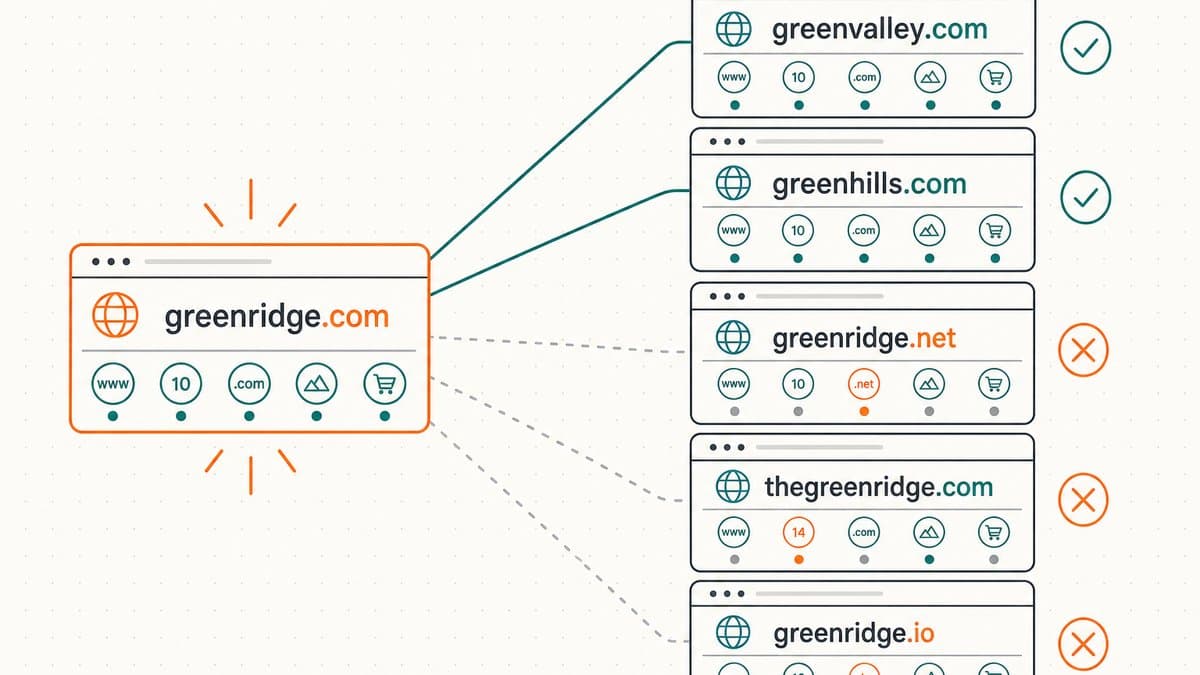
A comp is only useful if it's genuinely like your name. The single most common appraisal error is treating any sale that contains your keyword as evidence for your price. It isn't. A true comparable matches your name on the dimensions that actually drive value, not just the word.
Work down this checklist, hardest constraint first:
- Same extension. A
.comsale is not a comp for a.netor a.coname, full stop. The extension is one of the biggest price levers there is, and mixing them is the fastest way to fool yourself. If you're pricing a.io, find.iocomps; if you're pricing a.xyz, find.xyzcomps. We cover why the gap is so large in how the TLD affects domain value. - Same length class. One-word names, short two-word names, three-or-more-word names, and names padded with numbers or hyphens are different asset classes. A four-letter brandable doesn't tell you much about a fifteen-character three-word phrase.
- Same keyword family and commercial intent. A word tied to a transaction (
loans,insurance,casino) trades on a different curve than a hobby word. Match the kind of word, not just the topic.puppiesandmortgagesare both common English nouns; they are not comps for each other. - Same buyer type. This is the one new flippers miss. A sale to another investor at wholesale and a sale to an end user at retail can be the same name at wildly different prices. A reseller comp tells you what to pay; an end-user comp tells you what you might get. Don't average them — they're measuring two different markets, which is the whole point of end-user vs reseller domain pricing.
- Recent enough to matter. A sale from a hot year prices differently than one from a flat year. Weight recent comps more heavily and treat anything several years old as directional, not decisive.
A comp that matches on all five is gold. A comp that matches on two is a starting point you'll have to adjust hard. A comp that matches on one — just the keyword — is barely evidence at all.
Adjusting for the differences that always exist
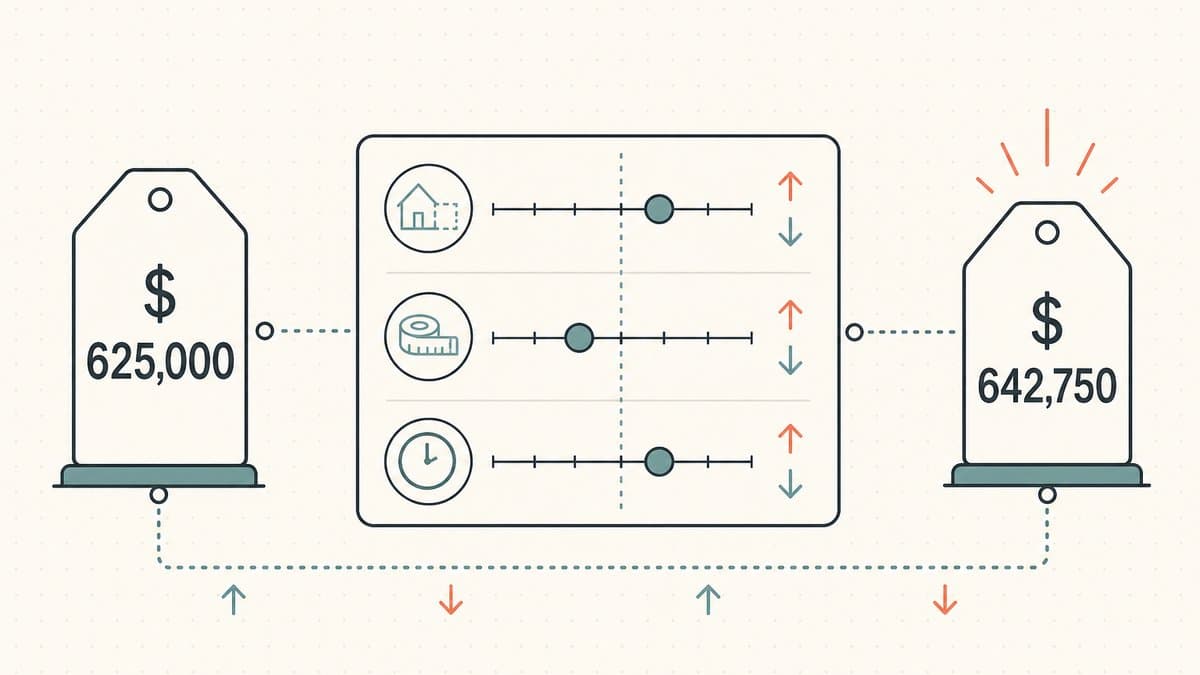
No two domains are identical, so every comp needs adjustment. This is where appraisal becomes a skill rather than a lookup. The discipline is simple to state: start from the comp's price, then move it up or down for each way your name differs.
Extension. .com is the benchmark the rest of the market is priced against. If your comp is a .com and your name isn't, adjust down — often steeply — because the same string on a less-trusted extension commands less. If you're lucky enough to have the .com and your comp is a weaker extension, adjust up. Premium extensions break the rule in their niche: a developer tool on .io or an AI startup on .ai can price near or above a generic .com, and the aftermarket has noticed — .ai dollar volume in 2024 more than doubled, rising 107%. Price the extension's market, not just the extension.
Length and construction. Shorter and cleaner adjusts up; longer, hyphenated, or number-padded adjusts down. If your comp is cars.com-class and your name is bestcars-online.com, the comp is a ceiling you're nowhere near, not a floor.
Word strength. A real, searched, easily spoken word adjusts up against a comp built on a weaker word, and down against a stronger one. Be honest here. The fact that a comp contains your keyword doesn't mean it carries the same demand — flowers and flowerz are not the same asset even though a naive match would pair them.
Market timing. If your strongest comp is from a hotter year, discount it toward today's conditions. If the market has heated up since, nudge upward. The 32.8% swing in a single year is a reminder that "what it sold for" and "what it would sell for now" are different questions.
Attached value. Some sales aren't really comps for a bare name at all, because the buyer was paying for a business, not a string. When QuinStreet bought CarInsurance.com for $49.7 million in cash in 2010, the price wasn't for the name in isolation. Domain Name Wire reported that the value comes primarily from the organic traffic the site receives and how that converts into leads. Using a sale like that as a comp for a parked, traffic-free domain in the same niche would inflate your number by millions. Strip the attached value out before you compare, or don't use the sale at all.
The cherry-picking trap

Here is the mistake that ruins more appraisals than every other combined: you find the one stratospheric sale in your keyword family, anchor to it, and ignore the hundred ordinary ones around it. It's the easiest trap in the business because the data invites it — the biggest sales are the most famous, the most quoted, and the most emotionally satisfying to find.
The public record is built to tempt you this way. Wikipedia's list of the most expensive domain names only catalogs sales with values of $3 million USD or more, and is limited to pure domain name and cash-only sales. Those headline numbers — Voice.com at $30 million in 2019, Sex.com at $13 million in 2010, Hotels.com at $11 million in 2001 — are real, verified, and completely useless as comps for a normal name. They are one-word, dictionary-grade .coms sold to buyers with an existential need and a deep balance sheet — the same dynamic behind a rebrand like TeslaMotors.com to Tesla.com, where the buyer's need set the price, not the wider market. They tell you the ceiling of the entire market, not the price of your name.
The fix is to price to the distribution, not the peak. When you pull comps, gather the whole spread, not the top of it. Look at the median and the cluster of sales that look most like yours, and treat the high outlier as exactly that — an outlier you exclude unless your name genuinely belongs in its company. A useful habit: throw out your single highest and single lowest comp, then build your range from what's left. If your defensible price depends entirely on one sale, you don't have a comp-backed price. You have a hope, and hope is not an appraisal.
Cherry-picking also runs in reverse. A buyer negotiating against you will pull the lowest comparable sale and present it as the market. The same discipline protects you in both directions: know your full distribution, name your real comparables, and you can defend your number against the dreamer and the lowballer alike.
A quick worked example
Say you hold BudgetTravel.io and want a price. The wrong move is to find Travel.com's famous sale and dream. The right move runs the checklist.
Start with extension: you need .io comps, so set aside the .com sales no matter how tempting. Set length and construction: BudgetTravel is a clean, common two-word phrase, so weight comps that are also short, real two-word names over keyword-stuffed or hyphenated ones. Match the keyword family: travel is a real commercial category with end-user demand, so don't compare against hobby-word sales. Check buyer type: separate the wholesale .io flips from any end-user .io sales, and decide which number you're estimating. Then adjust for timing, nudging older comps toward current conditions.
What you end up with is a range anchored to a cluster of genuinely similar sales, with the outliers excluded and each remaining comp adjusted for how it differs from your name. That range is a price you can defend in a negotiation — which is exactly what an appraisal is for. When the negotiation turns into a deal, the next problem is settling it safely; that's the job of escrow and the workflow we cover in domain escrow explained and how to sell a domain name you own.
The Namefi angle
Reading comps tells you what a name is worth. The other half of the trade is proving the name actually changed hands cleanly once you've agreed on the number. High-value domain trades stall on the same trust gap every time: the buyer doesn't want to pay before they control the asset, and the seller doesn't want to release it before the money clears.
This is the gap Namefi is built to narrow. Tokenizing a real ICANN domain makes ownership auditable and transferable, with DNS continuity so the name keeps resolving through the handover. Comps give you a number you can defend; a clean, verifiable transfer is what turns that number into a closed deal without either side moving first on faith.
Friendly Disclaimer (Read Me!)
We're not lawyers, accountants, financial advisors, or doctors, and nothing in this article is legal, financial, tax, accounting, medical, or any other flavor of professional advice. We write these posts to educate ourselves and as a convenience for our customers. Info here may be out of date, geography-specific, or just plain wrong. We make mistakes too.
For any important decision, please consult a real professional (seriously!). Or if that's not your vibe, ask a friend, ask Twitter, ask Reddit, ask an AI, or ask a psychic. In short: DOYR - Do Your Own Research. Let's learn and have fun.
Sources and further reading
- Wikipedia — Domain aftermarket (NameBio 2024: 144,700 sales / US$185M; .com 74.4% of dollar volume; +32.8% YoY; .ai +107%)
- Wikipedia — List of most expensive domain names (Voice.com $30M/2019, Sex.com $13M/2010, Hotels.com $11M/2001; $3M+ public, cash-only scope)
- GoDaddy — Domain Name Value & Appraisal tool (machine learning + real market sales data; provides comparable sales)
- GlobeNewswire — QuinStreet Announces Acquisition of CarInsurance.com, Inc. ($49.7M cash, 2010)
- Domain Name Wire — QuinStreet Bought CarInsurance.com for the Organic Traffic
Contributors

Fenwei Bian is a software developer in her thirties who spends her working hours in pull requests and her weekends with her hands in soil or sawdust. Years of open source on GitHub taught her that names are interfaces: a good one is clear, honest about what it does, and kind to whoever has to use it next.
She gardens because it rewards patience and punishes wishful thinking, and she does woodwork because a joint either fits or it doesn't. Both habits show up in how she writes about naming — measure twice, check the source, and don't sand over a rough spot and hope no one notices.
For Namefi she writes about how domain markets actually move, the practical trade-offs of tokenizing and flipping names, and picking a domain you'll still be glad you own in twenty years.

Victor Zhou is a technology founder and standards editor focused on digital identity and trust. He founded Namefi, edits Ethereum Improvement Proposals, and previously led smart-contract architecture work at Google Labs.
His work sits at the intersection of naming, ownership, and the systems people use to establish identity online. That perspective makes him especially interested in the way names move between personal meaning, public recognition, and digital infrastructure.
For Namefi, Victor edits and writes about domains as durable digital identity: how names become ownable onchain assets, how tokenization changes custody and trust, and what naming can learn from the systems people use to establish identity online.
Related guides
- For-Sale Landing Pages That ConvertHow to build a domain for-sale landing page that converts: a clear price or offer path, real trust signals, and a frictionless way to buy or make an offer.
- Running a Domain Portfolio Like a BusinessRun your domains like inventory: track cost basis, watch sell-through rate, control renewal drag, prune losers, and keep the books clean.
- Domain Pricing Psychology: Buy-Now vs Make-OfferHow listing mode and initial numbers can influence a domain sale: anchoring, when to name a price, planned concessions, and buy-now vs make-offer.
- Hand-Registering Domains to Flip: Finding Available GemsHow to find still-available domains worth a registration fee: wordlists, TLD permutations, brandable patterns, and the filters that beat impulse buys.